Ever felt a stabbing pain the instant your foot touched the floor after getting out of bed?
It’s easy to brush it off as “I guess I was just extra tired yesterday,” but if the same pain shows up every single day, it’s a classic sign of morning foot pain.
It may not be simple fatigue — it could be your foot tendons sending you a warning.

Key takeaway
Morning foot pain occurs when the plantar fascia (the band of tissue on the sole of your foot), which tightens while you sleep, suddenly has to bear your full body weight the moment you get up — causing tiny amounts of damage.
Plantar fasciitis, Morton’s neuroma, and Achilles tendinitis are the most common underlying conditions, and if left unaddressed, the pain can progress into a chronic gait problem, which is why early stretching and care matter.
Why does foot pain get worse the moment you step out of bed?
The short answer: it’s because the plantar fascia, which tightened overnight, suddenly has to bear your full body weight the moment you get up.
The plantar fascia is a thick band of fibrous tissue running from the heel bone to the toes, and it supports your foot’s arch while absorbing impact.
While you sleep, your ankle naturally stays in a relaxed, downward-pointing position.
During those hours, the plantar fascia stays contracted.
But the moment you get up in the morning and put weight on your foot,
the tightened tissue suddenly stretches out and sustains micro-damage.
That’s what triggers the sharp, stabbing pain.

Many people brush it off because the pain seems to ease after a few steps.
But if this pattern repeats over time, it can worsen into a chronic gait problem that makes walking itself difficult.

· According to the American Academy of Family Physicians (AAFP), about 94% of plantar fasciitis patients report their pain is most severe during the first steps of the morning.
· According to National Health Insurance Service data (2010–2014), the number of patients treated for plantar fasciitis roughly doubled over five years, from about 91,000 in 2010 to about 179,000 in 2014.
Assuming “it’ll feel better once I’m up and moving” and ignoring the pain can allow it to become chronic, with discomfort lasting all day.
What are the 3 main conditions that cause morning foot pain?
Morning foot pain is generally caused by one of three conditions: plantar fasciitis, Morton’s neuroma, or Achilles tendinitis.
Since the location and cause of the pain differ for each, it’s worth learning to tell them apart.
Plantar fasciitis is inflammation of the thick band of tissue that runs from the heel bone to the base of the toes.
Pain tends to concentrate on the inside of the heel,
and the risk rises with prolonged standing or frequently wearing shoes with little cushioning.
“Plantar fasciitis is a condition in which repeated strain and overload on the plantar fascia — which supports the foot’s arch and absorbs impact — leads to inflammation and pain.”
This definition comes from South Korea’s national health information portal, maintained by the Korea Disease Control and Prevention Agency.
Morton’s neuroma occurs when a nerve leading to the toes becomes compressed and thickens, causing pain in the front of the foot.
It typically produces a tingling or burning sensation between the third and fourth toes.
Frequently wearing narrow-toed shoes or high heels raises the risk.
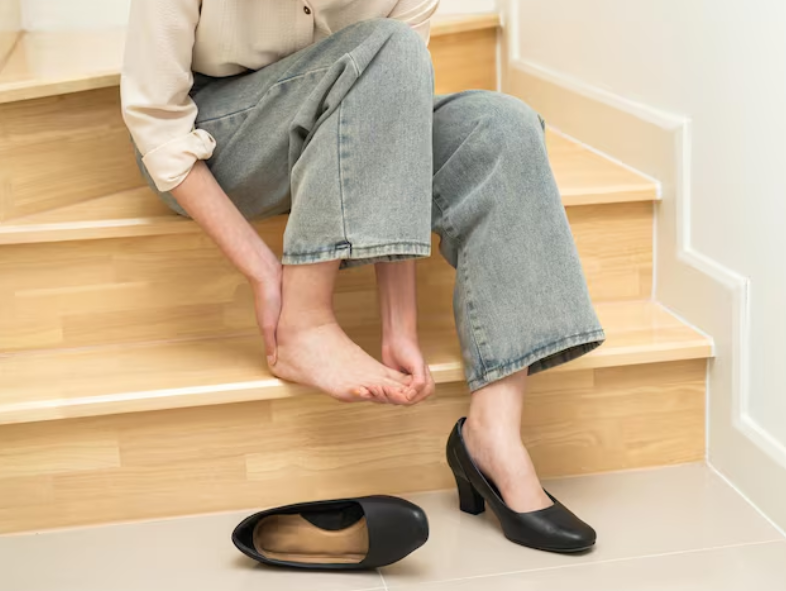
Achilles tendinitis is an inflammatory condition caused by overuse of the Achilles tendon at the back of the ankle.
Pain tends to spread from the upper heel through the entire sole of the foot.
A sudden jump in exercise intensity or excessive walking are common triggers.
| Condition | Pain Location | Main Causes |
|---|---|---|
| Plantar fasciitis | Inside of the heel | Prolonged standing, shoes with little cushioning |
| Morton’s neuroma | Between the 3rd and 4th toes | Narrow-toed shoes, high heels |
| Achilles tendinitis | Upper heel to entire sole | Sudden increase in exercise, excessive walking |

✅ Your inner heel feels a sharp twinge when you get up in the morning
✅ Your sole feels stiff and achy after sitting for a long time
✅ You feel a burning sensation or like you’re stepping on sand between your toes
✅ The back of your ankle and your heel feel heavy and sore after exercise
· According to data released by South Korea’s Ministry of Health and Welfare (2016), women were treated for plantar fasciitis about 1.4 times more often than men.
· If 2 or more items on the checklist above apply to you, it’s a good idea to see an orthopedic specialist.
How should you stretch and manage morning foot pain?
In short, just 1–2 minutes of gentle stretching before getting out of bed may help ease the pain.
The key is to stretch the plantar fascia before you actually stand up.
- While still lying in bed, slowly pull your toes and ankle toward your body.
- Use your hand to gently pull your toes back and hold for 10–15 seconds.
- Alternate between feet and repeat 3–4 times.
- After stretching, shift your weight on gradually as you take your first step.

Stretching alone, however, may not be enough.
The shoes you choose also play a big role in managing the pain.
Look for shoes with shock-absorbing cushioning and an appropriate heel height.
Walking barefoot on hard floors adds extra impact to the heel and may make the pain worse.

Consistent plantar fascia stretching combined with supportive footwear may help distribute the body-weight load placed on the sole during walking.
If symptoms last more than 2 weeks or get worse, self-care alone may not be enough.
In that case, an accurate diagnosis from an orthopedic or pain management specialist is needed.
Visit the SL Seoul Spine & Joint Hospital homepage to check available treatments and how to book a consultation.
Frequently Asked Questions
1. The pain only happens in the morning and eases once I start walking — is it okay to just leave it alone?
Answer: In the early stages, pain may ease with activity, but if left unaddressed it can become chronic, with discomfort persisting throughout the day. Getting an accurate assessment and starting care early matters.
2. Does a warm foot soak help relieve foot pain?
Answer: A lukewarm foot soak may help improve blood flow around the foot and relax a tight fascia.
3. Isn’t walking barefoot at home good for my feet?
Answer: Putting your full weight directly on a hard floor can increase the impact on your heel, so wearing cushioned indoor slippers may offer better protection.
4. Which specialist should I see?
Answer: It’s recommended to get a diagnosis from a specialist at a facility that treats foot conditions, such as an orthopedic clinic or a pain management clinic.
5. How long does it take for morning foot pain to improve?
Answer: Recovery time varies by person, and consistent stretching and care may help ease symptoms gradually over time. If symptoms persist, a consultation with a specialist is recommended.

References
· South Korea’s Ministry of Health and Welfare, “Plantar Fasciitis — the ‘Sole Pain’ Condition — Nearly Doubled Over 5 Years,” Ministry of Health and Welfare press release, 2016. View source
· Korea Disease Control and Prevention Agency, “Plantar Fasciitis,” National Health Information Portal, 2024. View source
· American Academy of Family Physicians, “Plantar Fasciitis,” American Family Physician, 2019. View source
This article is intended for general health information purposes only and is not a substitute for individual diagnosis or treatment. If you’re experiencing symptoms, please consult a medical professional.