You’ve probably felt it before — a sudden jolt of pain in your shoulder while reaching up to grab something off a shelf.
Shoulder pain when lifting your arm, which you may have brushed off as simple muscle fatigue, can end up throbbing at night and keeping you awake.
If you’ve been putting off a doctor’s visit, it’s worth pinpointing the exact cause first.
How you manage this pain depends entirely on what’s causing it.
Below, we break down the differences between the three most common causes — shoulder impingement syndrome, frozen shoulder, and rotator cuff tear — and walk through shoulder stretches you can do at home.

Is Shoulder Impingement Syndrome Causing Shoulder Pain When Lifting Your Arm?
Yes — if pain repeatedly occurs at a specific angle when you raise your arm, shoulder impingement syndrome is a likely cause.
Shoulder impingement syndrome occurs when the rotator cuff tendons become repeatedly pinched in the narrow space beneath the acromion bone, causing inflammation.
A hallmark sign is a pinching sensation or pain when raising your arm through the 60-to-120-degree range.
Pain is often milder during the day, when gravity works in your favor, but tends to worsen at night.
Overusing the shoulder or holding poor posture for long periods can raise the risk of developing it.

Without proper early care, it can progress to tendon damage — in other words, a rotator cuff tear — so caution is warranted.

Sleeping on your stomach or lying with the painful shoulder facing down can easily make symptoms worse.
It’s best to sleep with the affected shoulder facing up whenever possible.
When you feel pain, avoid forcing your arm upward and prioritize adequate rest first.
If the pain persists for more than two weeks even after rest, it’s best to see a specialist.
How Do You Tell Frozen Shoulder and a Rotator Cuff Tear Apart?
The easiest way to tell them apart is to check whether your arm can be raised when someone else lifts it for you.
Frozen shoulder (adhesive capsulitis) occurs when the joint capsule tightens and becomes inflamed, causing the entire shoulder joint to stiffen.

A rotator cuff tear, by contrast, occurs when the tendons that move the shoulder are themselves damaged.
The two conditions can look similar, but they show a clear difference in passive range of motion.

| Category | Frozen Shoulder (Adhesive Capsulitis) | Rotator Cuff Tear |
|---|---|---|
| Passive Motion | Arm doesn’t lift well even when someone else raises it | Arm lifts fine when someone else raises it |
| Pain Location | Overall shoulder pain and stiffness | Localized pain and muscle weakness |
| Key Symptom | Restricted range of motion in every direction | Arm may suddenly drop due to weakness when lifting |

✅ You have trouble putting on clothes by reaching behind your back
✅ Shoulder pain worsens at night and disrupts your sleep
✅ You hear a click or feel catching in your shoulder when raising your arm
✅ Pain occurs only at certain angles and eases once your arm is fully raised
✅ Your arm has gone weak enough to drop something you were holding
Frozen shoulder sometimes improves gradually on its own over time, but a rotator cuff tear can widen the longer it goes untreated, so early diagnosis matters.
What Stretches Help Relieve Shoulder Pain?
Doing gentle towel stretches consistently, within a pain-free range, can help restore your shoulder’s range of motion.
Restoring shoulder range of motion refers to gradually loosening the muscles and ligaments around a stiffened joint to regain movement.
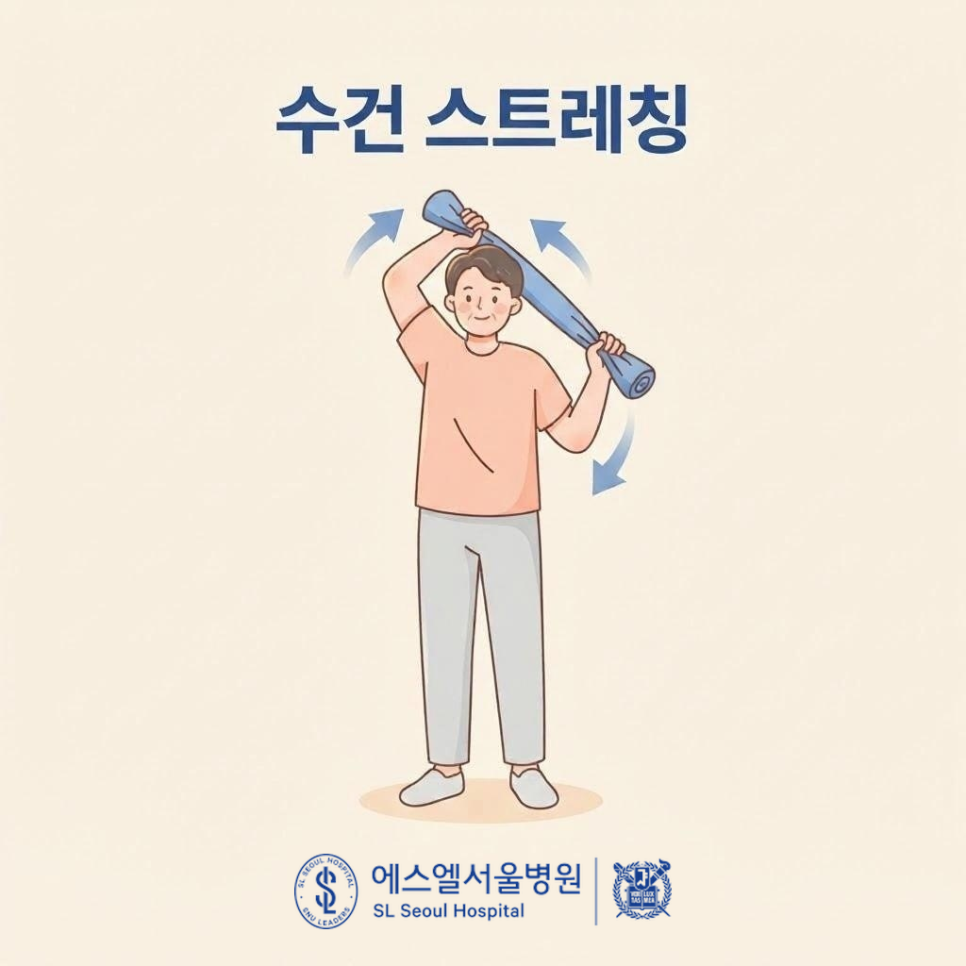
Here’s a simple towel stretch you can try at home:
- Hold each end of a towel with your hands.
- Slowly raise your arms as far as you can without pain.
- Hold for 2 to 3 seconds, then lower slowly.
- Repeat about 10 times per session, 2 to 3 times a day.

Forcing the stretch with bouncing movements while in significant pain can make symptoms worse.
If the pain lasts more than two weeks or disrupts your sleep at night, we recommend getting an accurate diagnosis at Spine & Joint SL Seoul Hospital.
Frequently Asked Questions
1. Is heat or ice better for shoulder pain?
For acute pain or right after an injury, ice may help reduce inflammation and swelling. For chronic stiffness like frozen shoulder, heat can help by improving blood circulation.
2. Can I keep exercising if my shoulder hurts?
You should avoid heavy movements that trigger pain. It’s best to stick to light mobility exercises and stretches that stay within a pain-free range.
3. What happens if shoulder pain is left untreated?
Avoiding movement because of the pain can cause the joint to stiffen further and lose range of motion. It’s important to identify the exact cause and address it early.
4. Can shoulder impingement syndrome heal on its own?
In early stages, rest and stretching can sometimes lead to improvement, but if symptoms keep recurring or worsening, it may progress to rotator cuff damage — professional evaluation is needed.

References
· Myongji Hospital Sports Medicine Center, “Frozen Shoulder and Rotator Cuff Tear,” Myongji Hospital. View source
· Barunsesang Hospital, “Shoulder Impingement Syndrome: Symptoms, Causes, and Treatment,” Barunsesang Hospital. View source
· St. Luke’s Hospital, “Heat or Ice for Shoulder Stiffness and Pain?,” St. Luke’s Hospital. View source
This article is intended for general health information purposes only and is not a substitute for individual diagnosis or treatment. If you’re experiencing symptoms, please consult a medical professional.