Category: Uncategorized

  • Shoulder Tension Stretches: 2 Trapezius Moves in Just 5 Minutes a Day

    Shoulder Tension Stretches: 2 Trapezius Moves in Just 5 Minutes a Day

    SummaryHere’s everything you need to know about shoulder tension stretches: why the trapezius muscle tightens, plus how to choose between heat and cold therapy. Spend just 5 minutes a day building a habit that helps manage neck and shoulder pain.

    Do you find yourself rubbing your shoulders the moment you wake up?
    Most of us have felt that letdown when a massage only helps for a little while.

    The truth is, just a few minutes of shoulder tension stretches can make a real difference.
    The cause usually isn’t a lack of massages — it’s the small posture habits you repeat every day.

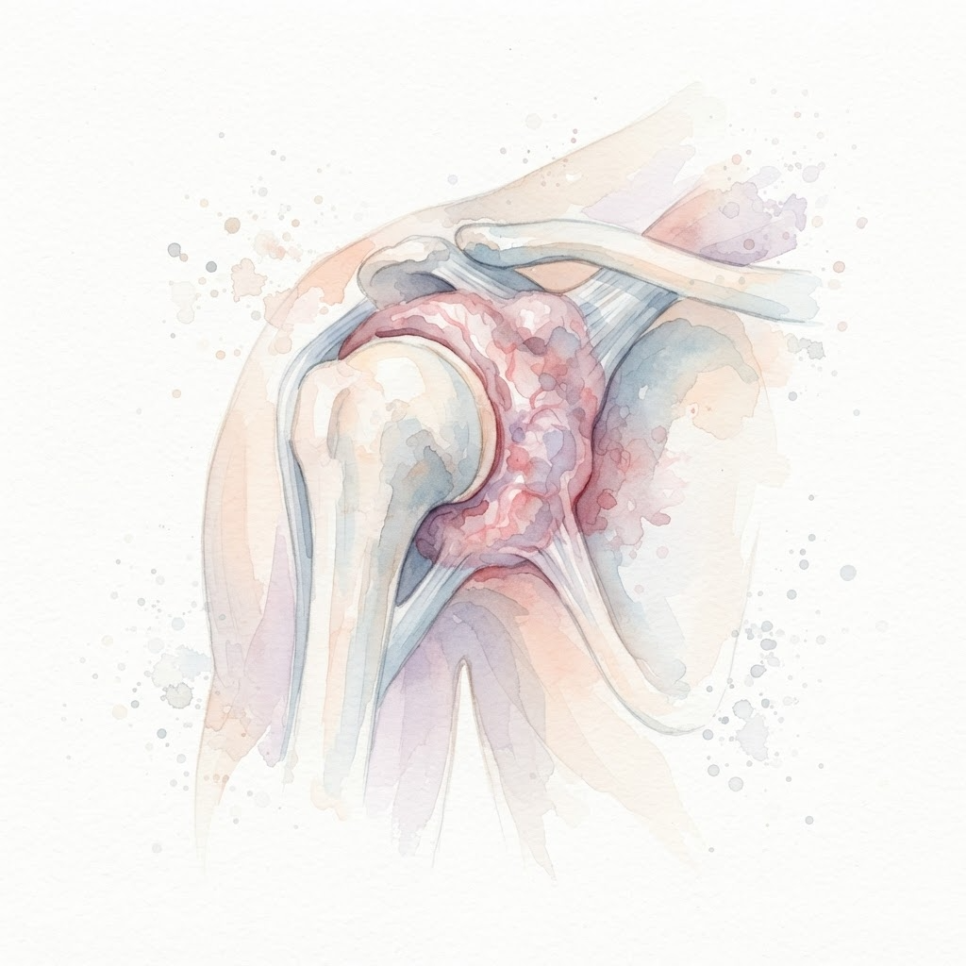
    어깨결림 스트레칭

    📌 Quick Preview
    This article covers the root causes of a tight trapezius and two shoulder tension stretches you can do right at your desk.
    Reviewing your posture habits alongside these stretches can also help prevent tension from coming back.

    Why Does Shoulder Tension Keep Coming Back?

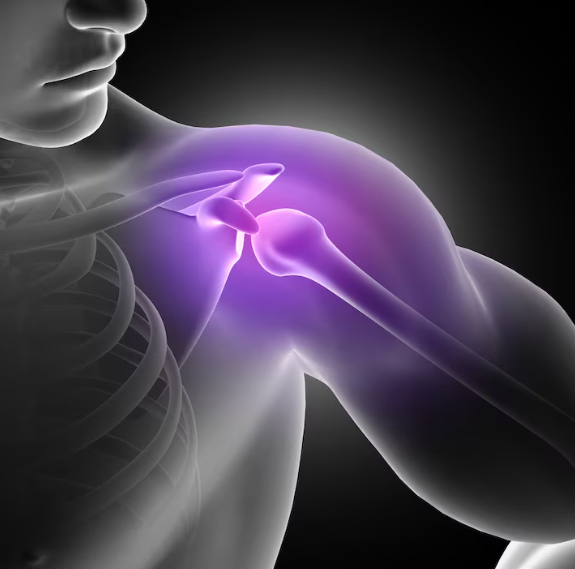
    Shoulder tension develops when the trapezius and surrounding neck and shoulder muscles stay tight for extended periods.
    Shoulder tension refers to a condition where the trapezius and nearby muscles remain persistently tight, causing pain and stiffness.

    A common cause is forward head posture from long hours spent looking at a computer or smartphone.
    According to information shared through Korea’s national policy briefing service, every 1 cm the head shifts forward adds roughly 2–3 kg of extra load on the cervical spine.

    어깨결림 스트레칭 관련 이미지 2

    This forces the muscles at the back of the neck to bear an excessive share of the head’s weight.
    Over time, fatigue-related byproducts build up in the muscle and blood circulation is disrupted as well.

    When these muscles become tightly knotted, it can even contribute to headaches or eye strain, so it’s worth paying attention early.
    Left unaddressed, the tension can progress into chronic pain, which is why releasing it early matters.
    어깨결림 스트레칭 관련 이미지 3

    ⚠️ Main Causes of Shoulder Tension
    · Maintaining poor posture for long periods
    · Muscle tension caused by stress
    · Lack of exercise and reduced blood circulation

    What Shoulder Tension Stretches Can You Do at Home?

    Shoulder tension stretches are movements that slowly lengthen a tight trapezius to support blood circulation and ease tension.
    They’re simple enough to do right where you’re sitting.

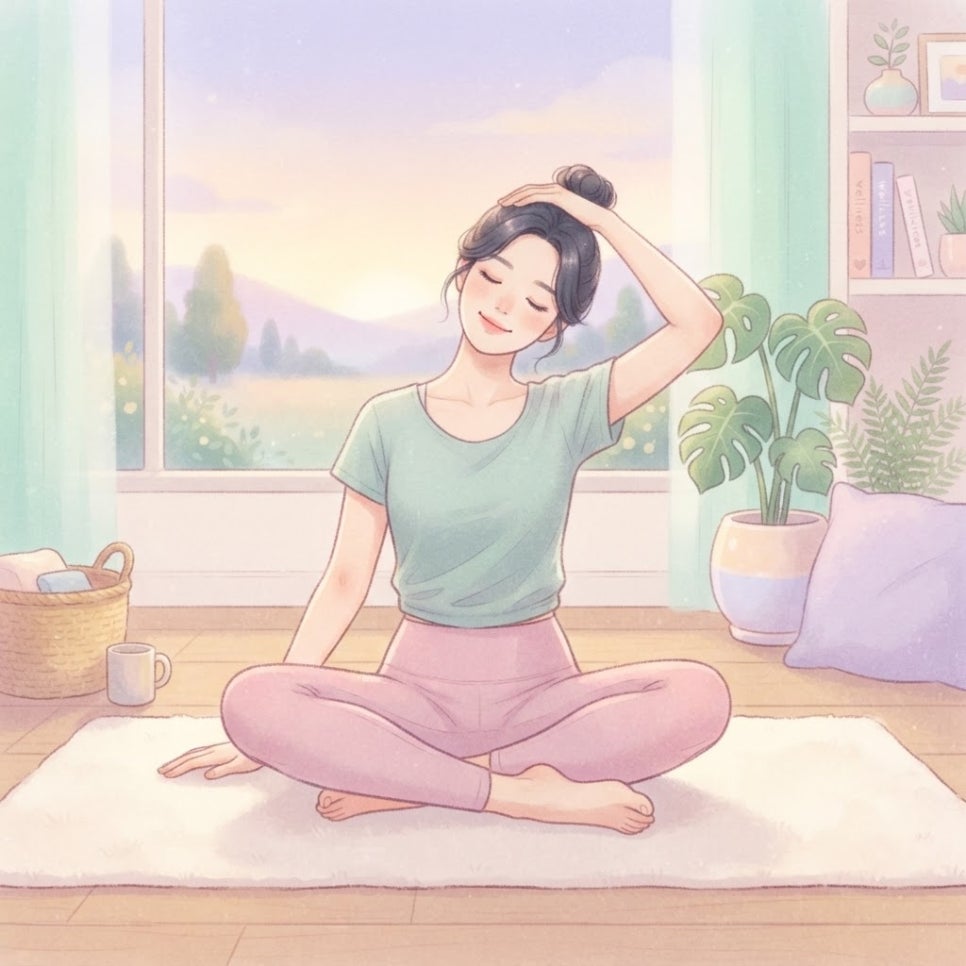
    Move 1: Trapezius Stretch

    1. Sit up straight and place your right hand on the left side of your head.
    2. Gently tilt your neck to the right, as if pulling it in that direction.
    3. When you feel a comfortable stretch, hold for 15 seconds while breathing slowly.
    4. Repeat on the other side.

    어깨결림 스트레칭 관련 이미지 4

    Repeating this may help loosen up tightness along the neck and shoulder line.

    어깨결림 스트레칭 관련 이미지 5

    Move 2: Shoulder Blade Squeeze

    1. Raise both arms to a 90-degree angle.
    2. Open your chest as if drawing your shoulder blades together.
    3. Keep your shoulders pulled down so they don’t rise up toward your ears.
    4. Repeat consistently at least 3 times a day.
    📌 Key Points to Remember Before Stretching
    · Stretch only to the point of a comfortable pulling sensation, not pain
    · Keep breathing slowly instead of holding your breath during each move
    📋 Stretching Routine Checklist
    ✅ Neck stretch, left and right (15 seconds x 3 sets)
    ✅ Shoulder blade squeeze to open the chest (10 seconds x 5 sets)
    ✅ Big shoulder rolls backward (10 reps)
    ✅ Changes You May Notice With Consistent Practice
    · May help reduce tension in tight muscles
    · May help improve blood circulation around the neck and shoulders

    What Daily Habits Help Prevent Shoulder Pain?

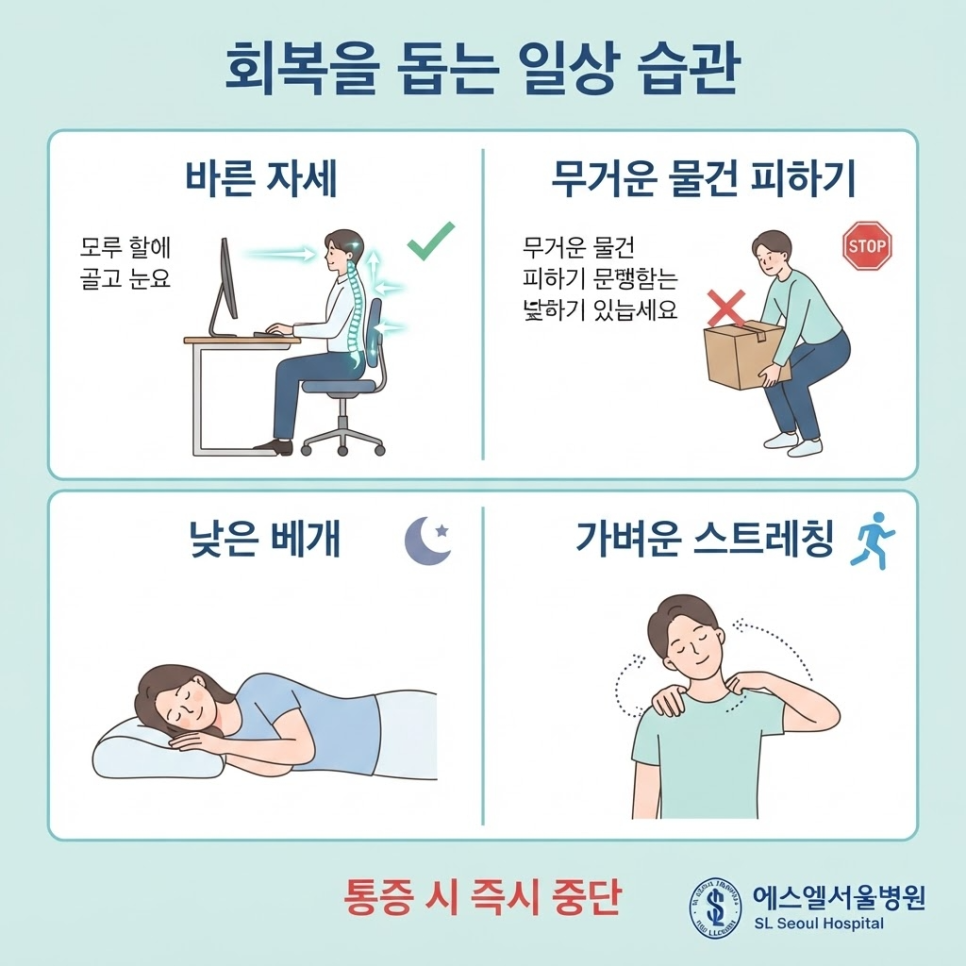
    Preventing pain relies just as much on maintaining good posture throughout the day as it does on stretching.
    If you don’t change your everyday habits, tension tends to come right back no matter how much you stretch.

    It helps to adjust your monitor so the screen sits at eye level.
    When looking at your phone, try raising it to eye level instead of tilting your head down.

    어깨결림 스트레칭 관련 이미지 6

    If your work requires staying in one position for long stretches, the general rule is to take a short break every 50 minutes.
    Even something as simple as stretching your arms overhead or marching lightly in place can make a real difference.

    When Should You Use Heat vs. Cold Therapy?

    When managing an area that’s already tight, it’s important to use the right type of therapy.

    Category Cold Therapy Heat Therapy
    When to Use First 24–48 hours after acute pain begins Chronic tightness or tension
    Main Effect Reduces swelling and inflammation Promotes circulation, relaxes muscles
    Recommended Duration 15–20 minutes 15–20 minutes

    If pain keeps recurring even after combining stretches with better posture habits, it may be worth consulting a specialized medical center.
    Visit SL Seoul Hospital for Spine & Joints to learn more.

    🚀 Benefits of Maintaining Good Posture
    · May help reduce physical strain on the neck and shoulders
    · May help support recovery from fatigue through improved circulation
    · May help prevent chronic headaches and postural changes

    Frequently Asked Questions

    1. What should I do if stretching causes sharp pain?
    If you feel pain, stop the movement right away and reduce the intensity. Pushing through pain can actually damage the muscle.

    2. Is heat or cold therapy better for a tight shoulder?
    For tension that has lasted a while, heat therapy can help by supporting circulation. However, if there’s a sudden injury or acute inflammation, cold therapy should be applied first.

    3. How many times a day should I do shoulder tension stretches?
    Rather than sticking to a fixed schedule, it’s more effective to stretch frequently throughout the day. Try to move your shoulders and neck at least once an hour.

    4. If pain continues even with regular stretching, should I see a doctor?
    If pain keeps recurring or is accompanied by symptoms like arm numbness even after weeks of stretching and posture correction, it’s recommended to see a specialist such as an orthopedist.

    어깨결림 스트레칭 관련 이미지 7


    References

    · Korea Disease Control and Prevention Agency, “Text Neck (Forward Head) Syndrome,” National Health Information Portal. View source
    · Korea.kr Policy Briefing, “Stretches That Help Correct Forward Head Posture,” Ministry of Culture, Sports and Tourism. View source
    · St. Carollo Hospital, “Cold vs. Heat Therapy: When Should You Use Each?,” Health Information. View source


    This article is intended for general health information purposes only and is not a substitute for individual diagnosis or treatment. If you’re experiencing symptoms, please consult a licensed physician.

  • Shoulder Stiffness Stretches: 5 Minutes a Day, 2 Moves to Release Tight Traps

    Shoulder Stiffness Stretches: 5 Minutes a Day, 2 Moves to Release Tight Traps

    SummaryThis guide covers shoulder stiffness stretches, why the trapezius muscle tightens, and when to use heat versus cold therapy. Spend just 5 minutes a day building a habit that helps manage neck and shoulder discomfort.

    Do you find yourself rubbing your shoulders the moment you wake up?
    Most of us have felt that frustration of a massage helping only for a moment before the tension creeps right back.

    The truth is, just a few minutes of shoulder stiffness stretches may help.
    The cause usually isn’t a lack of massages — it’s the small posture habits we repeat every day.

    shoulder stiffness stretches

    📌 Quick Preview
    This article breaks down the root cause of trapezius tightness and two shoulder stiffness stretches you can do right at your desk.
    Reviewing your posture habits alongside these stretches can also help reduce recurrence.

    Why Does Shoulder Stiffness Keep Coming Back?

    Shoulder stiffness develops when the trapezius and the muscles around the neck and shoulders stay tense for extended periods.
    Shoulder stiffness refers to a state in which the trapezius and surrounding muscles remain chronically tense, causing pain and tightness.

    One common cause is the forward head posture that happens when we stare at a computer or smartphone for long stretches.
    According to information shared through South Korea’s official policy briefing service, every 1 cm the head shifts forward can add roughly 2–3 kg of extra load onto the cervical spine.

    Image related to shoulder stiffness stretches 2

    That’s because the muscles at the back of the neck end up bearing far more of the head’s weight than they should.
    Over time, fatigue byproducts build up in the muscle and blood circulation gets disrupted as well.

    When these muscles become tightly knotted, it can even lead to headaches or eye strain, so it’s worth paying attention early.
    Left unaddressed, the tension can progress into chronic pain, which is why releasing it early matters.

    Image related to shoulder stiffness stretches 3

    ⚠️ Main Causes of Shoulder Stiffness
    · Maintaining poor posture for long periods
    · Muscle tension from stress
    · Lack of exercise and poor circulation

    How to Do Shoulder Stiffness Stretches at Home

    Shoulder stiffness stretches are movements that slowly lengthen a tight trapezius to support circulation and ease tension.
    They’re simple enough to do right from your chair.

    Move 1. Trapezius Stretch

    1. Sit up straight and place your right hand on the left side of your head.
    2. Gently tilt your neck to the right, as if pulling with your hand.
    3. Once you feel a comfortable stretch, hold for 15 seconds while breathing slowly.
    4. Repeat on the opposite side.

    Image related to shoulder stiffness stretches 4

    Repeating this may help loosen the tight muscles along your neck and shoulder line.

    Image related to shoulder stiffness stretches 5

    Move 2. Shoulder Blade Squeeze

    1. Raise both arms to a 90-degree angle.
    2. Open your chest as if trying to bring your shoulder blades together.
    3. Keep your shoulders pulled down rather than letting them creep up toward your ears.
    4. Repeat consistently at least 3 times a day.
    📌 Key Points to Remember Before Stretching
    · Only stretch to the point of a comfortable pull, never to the point of pain
    · Keep breathing slowly throughout — don’t hold your breath
    📋 Stretching Routine Checklist
    ✅ Neck stretch, left and right (15 seconds x 3)
    ✅ Shoulder blade squeeze to open the chest (10 seconds x 5)
    ✅ Big shoulder rolls backward (10 reps)
    ✅ Changes You May Notice With Consistent Practice
    · May help reduce tension in tight muscles
    · May help support circulation around the neck and shoulders

    Daily Habits That Help Prevent Shoulder Pain

    Preventing pain relies just as much on maintaining good posture throughout the day as it does on stretching.
    If your everyday habits don’t change, the stiffness tends to come right back no matter how often you stretch.

    It helps to set your monitor at eye level.
    When looking at your phone, try raising it to eye level instead of tilting your head down.

    Image related to shoulder stiffness stretches 6

    If you do need to stay in one position for long stretches of work, the general rule is to take a short break every 50 minutes.
    Even something as simple as stretching your arms overhead or marching in place for a moment may help.

    When Should You Use Heat vs. Cold Therapy?

    When managing an area that’s already tight, it’s important to use the right type of compress.

    Category Cold Therapy Heat Therapy
    When to Use Within 24–48 hours of acute pain onset Chronic tightness or stiffness
    Main Effect Reduces swelling and inflammation Promotes circulation, relaxes muscles
    Recommended Duration 15–20 minutes 15–20 minutes

    If pain keeps coming back even after combining stretching with better posture habits, it may be worth having it evaluated at a specialized clinic.
    SL Seoul Hospital Spine & Joint Center homepage has more information on this topic.

    🚀 Benefits of Maintaining Good Posture
    · May help reduce physical strain on the neck and shoulders
    · May support recovery from fatigue through better circulation
    · May help prevent chronic headaches and postural changes

    Frequently Asked Questions

    1. What should I do if a stretch causes significant pain?
    Stop the movement immediately and ease off the intensity. Pushing through pain can end up damaging the muscle instead of helping it.

    2. Is heat or cold better for tight shoulders?
    For long-standing tightness and stiffness, heat therapy tends to help by supporting circulation. However, if there’s a sudden injury or acute inflammation, cold therapy should be applied first.

    3. How often should I do shoulder stiffness stretches each day?
    Rather than sticking to a fixed schedule, doing them frequently throughout the day tends to work better. Try to move your shoulders and neck at least once an hour.

    4. If the pain continues even with consistent stretching, should I see a doctor?
    If pain keeps recurring after several weeks of stretching and posture correction, or if it’s accompanied by symptoms like arm numbness, it’s advisable to see a specialist such as an orthopedic doctor.

    Image related to shoulder stiffness stretches 7


    References

    · Korea Disease Control and Prevention Agency, “Text Neck (Forward Head) Syndrome,” National Health Information Portal. View Source
    · Korea.kr Policy Briefing, “Stretches That Help Correct Forward Head Posture,” Ministry of Culture, Sports and Tourism. View Source
    · St. Carollo Hospital, “Cold vs. Heat Therapy: When Should You Use Each?,” Health Information. View Source


    This article is intended for general health information purposes only and is not a substitute for individual diagnosis or treatment. If you’re experiencing symptoms, please consult a medical professional.

  • Herniated Disc Treatment: 3 Non-Surgical Options to Try First

    Herniated Disc Treatment: 3 Non-Surgical Options to Try First

    SummaryWhen it comes to herniated disc treatment, surgery is often the first word that comes to mind — but in practice, doctors usually start with conservative options like medication, physical therapy, and manual therapy. This guide covers the diagnostic process, a symptom checklist, and exercises you can try at home.

    We often see patients hesitate at the front desk three days after tweaking their back.

    That’s because the word “surgery” is usually the first thing that comes to mind with a herniated disc diagnosis.
    In actual clinical practice, though, surgery isn’t the first option.

    In the early stages, doctors typically consider herniated disc conservative treatment — medication, physical therapy, and manual therapy — first, then decide on next steps based on how symptoms progress.

    This article explains what herniated disc conservative treatment involves, along with the symptoms and causes to watch for.

    We’ll also walk through the order of diagnostic tests, at-home care tips, and postures to avoid.

    Herniated disc conservative treatment

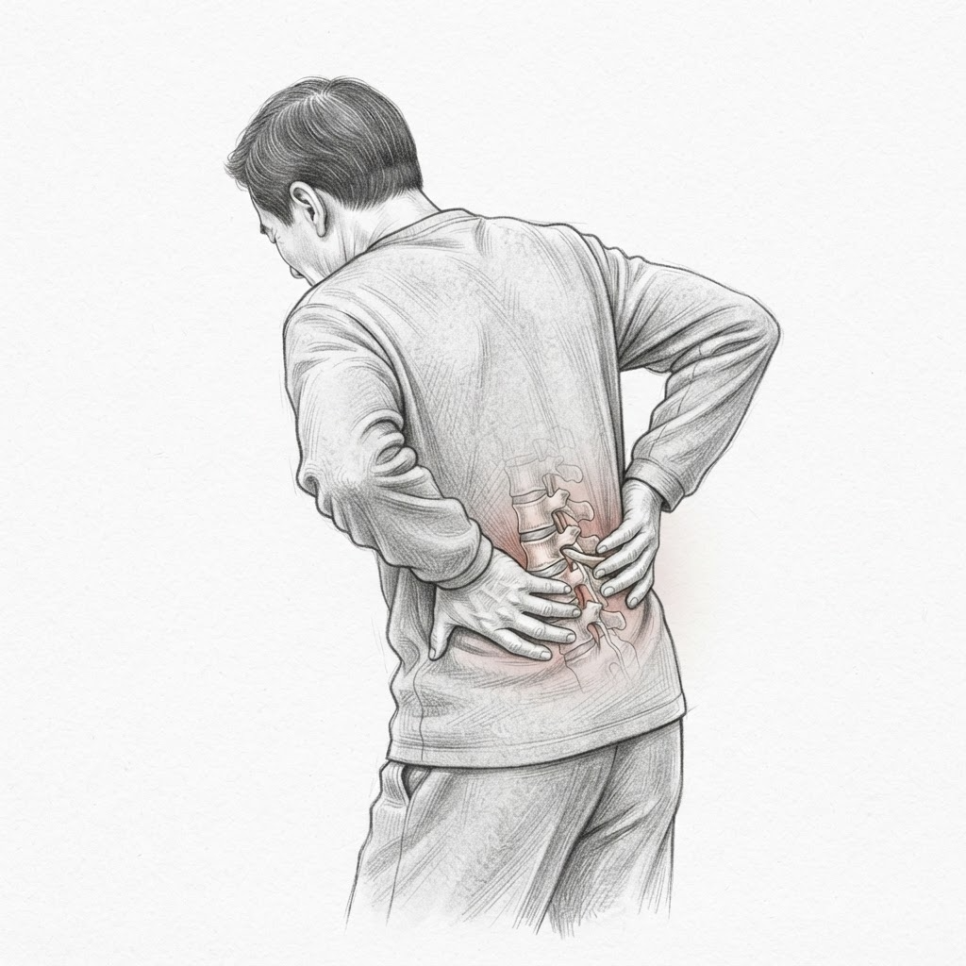
    Most people have woken up at some point with a stiff, heavy feeling in their lower back.

    Many assume it’s just muscle soreness and ignore it — until the tingling spreads down the leg and catches them off guard.
    Identifying the exact cause of the pain is essential.

    Herniated disc conservative treatment illustration 2

    Does a Herniated Disc Diagnosis Always Mean Surgery?

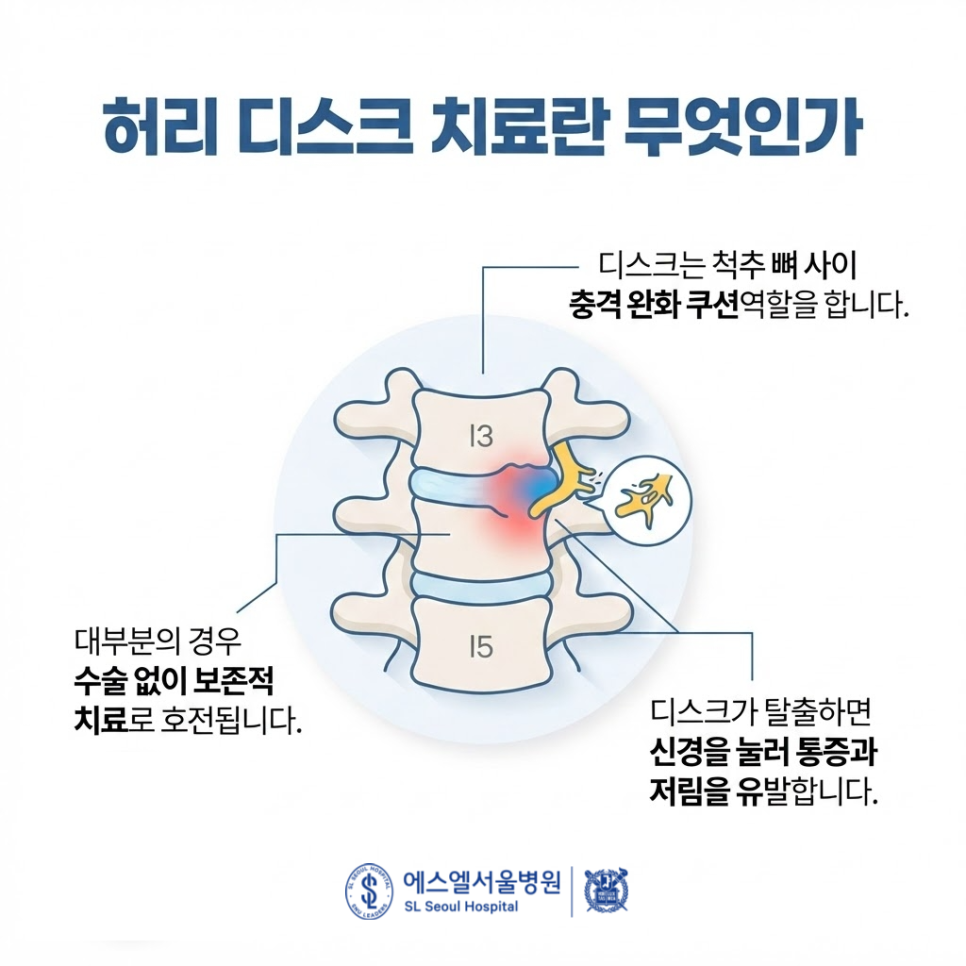
    The short answer is no. A herniated disc occurs when the disc between the vertebrae shifts out of place and presses on a nerve, causing pain and inflammation.

    The disc acts as a cushion, absorbing shock to the spine.
    When it slips out of position, it irritates the surrounding nerves.

    Herniated disc conservative treatment illustration 3

    In the early stages, herniated disc conservative treatment is typically considered before surgical options.

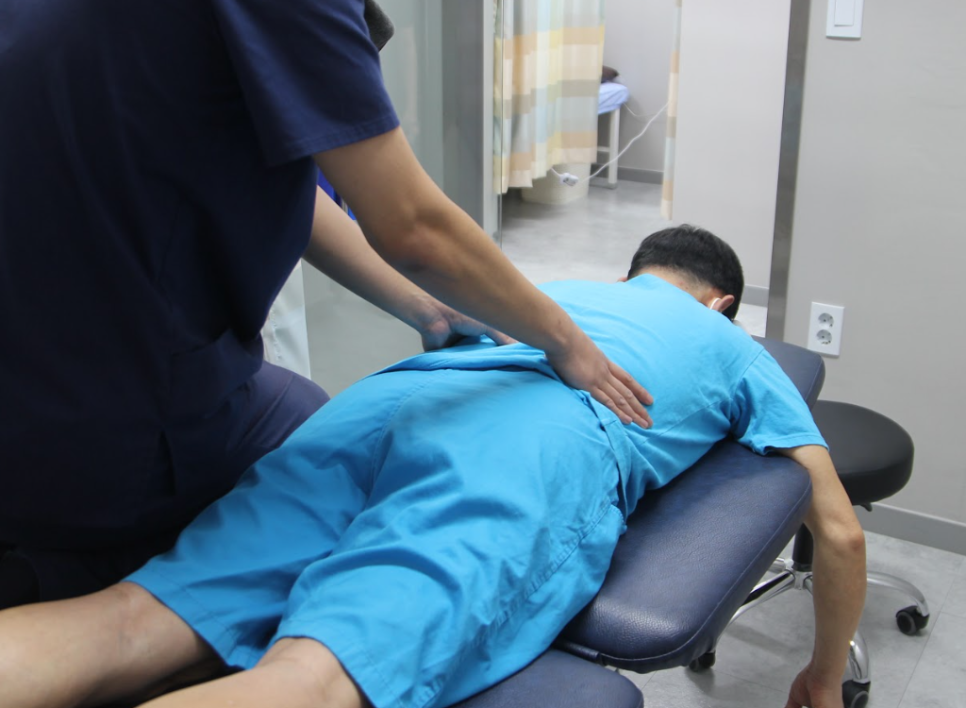
    This approach aims to reduce pain through medication, physical therapy, and manual therapy.
    Outcomes are generally reported to be more favorable when early diagnosis is paired with consistent management.

    💡 Key Takeaway
    Disc conditions tend to respond better when early diagnosis is combined with appropriate herniated disc conservative treatment.

    Herniated disc conservative treatment illustration 4


    Herniated Disc Symptoms and Causes: What Signs Should You Watch For?

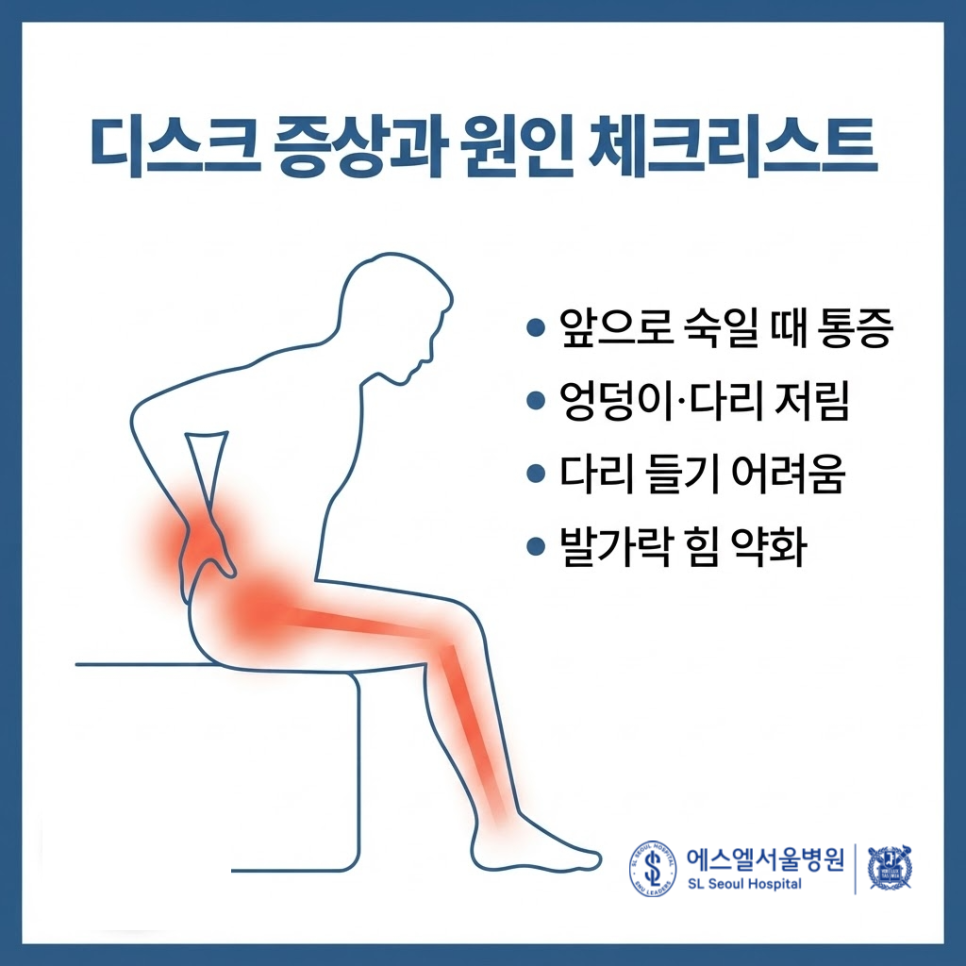
    Leg numbness, hip pain, and persistent lower back stiffness are common signs.

    Prolonged poor posture and degenerative spinal changes both add stress to the disc over time.

    Herniated disc conservative treatment illustration 5

    Sitting for long periods at work or frequently lifting heavy objects can also contribute.
    Sudden impact and muscle weakness from lack of exercise play a role as well.

    As symptoms worsen, you may even feel a jolt of pain in your lower back when coughing.

    If these symptoms recur, seeing a doctor for a proper diagnosis should come before self-diagnosis.

    Herniated disc conservative treatment illustration 6

    📋 Checklist: Signs That May Point to a Disc Problem
    ✅ Pain worsens when you bend forward
    ✅ Aching or tingling spreads through the hip or leg
    ✅ Difficulty lifting one leg while lying down
    ✅ Weakness in the toes or ankle

    What Is the Order of Tests for Diagnosing a Herniated Disc?

    Testing typically narrows down step by step, in the order of X-ray, MRI, and electromyography (EMG).

    An X-ray is taken first to check the spacing and alignment of the vertebrae.
    However, additional testing may be needed to assess the nerves and soft tissue.

    Herniated disc conservative treatment illustration 7

    An MRI shows relatively clearly how far the disc has protruded and how much it’s compressing the nerve.

    EMG testing checks for nerve damage using electrical signals.
    These step-by-step diagnostic tests help doctors design a treatment plan suited to your body type and symptom severity.

    📊 Data Insight
    Basing a herniated disc conservative treatment plan on a systematic diagnosis — tailored to body type and symptom severity — is key.

    Herniated Disc Treatment at Home: Conservative Care and Exercises

    The goal is to ease pain while strengthening the core muscles to reduce stress on the spine.

    When pain first starts, avoid overexertion — rest and apply heat instead.

    Herniated disc conservative treatment illustration 8

    ⚠️ Caution
    Avoid high-intensity movements that bend or twist the back excessively, and don’t jump straight into sit-ups.
    Overexerting yourself during a painful flare-up can slow recovery instead of helping it.

    Once the pain has eased somewhat, light stretching can begin.

    Walking can help strengthen the muscles around the spine.
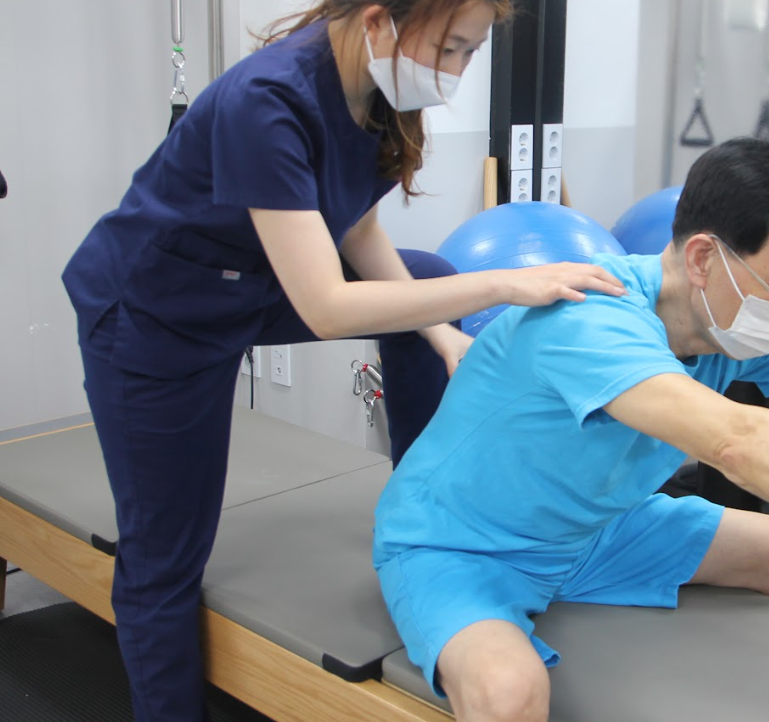
    Core exercises such as McKenzie exercises or planks can also be added.

    Herniated disc conservative treatment illustration 9

    🚀 Recommended Exercise Steps
    1. Walk slowly on flat ground for 30 minutes a day
    2. Gentle pelvic bridge exercises
    3. Maintain proper posture to keep your back straight

    If you’re not sure what to do on your own, the SL Seoul Hospital for Spine & Joints homepage is a good place to find more information on care options.

    Following exercise routines without an accurate diagnosis first isn’t recommended.


    Frequently Asked Questions

    1. If I’m diagnosed with a herniated disc, do I automatically need surgery?
    Not necessarily. Conservative treatments such as medication, physical therapy, and manual therapy are generally tried first and may help improve symptoms.

    2. When I’m in pain, is heat or ice better?
    Ice is better suited for sudden inflammation or acute pain, while heat can help chronic stiffness or muscle tightness by improving blood circulation.

    3. What exercises or postures should disc patients avoid?
    Bending forward excessively, sudden twisting movements, and sit-ups can put strain on the spinal disc, so caution is advised.

    4. When should I get a detailed diagnostic workup?
    If lower back pain is accompanied by leg numbness, altered sensation, or muscle weakness lasting more than two weeks, it’s advisable to see a doctor for a thorough evaluation.

    Herniated disc conservative treatment illustration 10

    Herniated disc conservative treatment illustration 11


    References

    · Korea Disease Control and Prevention Agency, “Herniated Disc (Intervertebral Disc Herniation),” National Health Information Portal. View source
    · Asan Medical Center, “Lumbar Disc Herniation (Herniated Disc),” Disease Encyclopedia. View source

    Herniated disc conservative treatment illustration 12

    Herniated disc conservative treatment illustration 13


    This article is intended for general health information purposes only and is not a substitute for individual diagnosis or treatment. If you’re experiencing symptoms, please consult a physician.
  • Frozen Shoulder Treatment: 3 Exercises Plus a Symptom Checklist

    Frozen Shoulder Treatment: 3 Exercises Plus a Symptom Checklist

    SummaryIf you’re wondering about frozen shoulder treatment, here’s what to know. This guide covers a self-check symptom checklist, how frozen shoulder differs from a rotator cuff tear, causes such as diabetes and thyroid disease, and stage-by-stage frozen shoulder treatment exercises for the acute and chronic phases. We’ll also cover when it’s time to see a specialist.

    Have you ever reached up to wash your hair,
    only to feel your arm lock up in pain?

    If one shoulder has grown stiff for no clear reason — no fall, no bump —
    and the pain keeps you up at night, it may be more than simple muscle fatigue.

    In that case, it’s worth considering frozen shoulder, a condition caused by inflammation of the joint capsule,
    since the symptoms can easily be confused with a rotator cuff tear or shoulder impingement syndrome.

    frozen shoulder treatment

    Before getting into frozen shoulder treatment options,
    it helps to start with a self-check checklist to assess your own shoulder.

    frozen shoulder treatment illustration 2

    For anyone weighing frozen shoulder treatment, this article lays out
    how to tell the symptoms apart, what causes the condition, and
    stage-by-stage management and exercises for the acute and chronic phases, in order.

    Read on to see how inflammation in the joint capsule tends to progress,
    and which exercises you can safely try at home.

    frozen shoulder treatment illustration 3

    What Exactly Is Frozen Shoulder?

    Frozen shoulder is a condition in which the joint capsule surrounding the shoulder becomes inflamed, thickens, and stiffens.

    Frozen shoulder, medically known as adhesive capsulitis, occurs when inflammation in the joint capsule limits both active and passive shoulder movement.

    According to Korea’s National Health Information Portal, frozen shoulder affects roughly 2% of the general population, making it a fairly common shoulder condition.
    It typically develops after age 50 without any specific injury.
    That said, younger adults who spend long hours on computers and smartphones can also report shoulder pain,
    so it’s worth paying attention to symptoms regardless of age.

    frozen shoulder treatment illustration 4

    Key Point
    The longer frozen shoulder goes untreated, the more the joint capsule can thicken and stiffen,
    and this progressive condition may eventually make it hard to raise your arm on your own.
    Starting frozen shoulder treatment early, as soon as symptoms appear, tends to support a smoother recovery.

    frozen shoulder treatment illustration 5


    What Are the Symptoms, and How Is It Different From Other Shoulder Conditions?

    Not all shoulder pain is frozen shoulder.

    Rotator cuff tears and shoulder impingement syndrome can cause similar pain,
    so an accurate diagnosis matters.

    The key difference: with frozen shoulder, the arm still won’t lift all the way even when someone else raises it for you.
    With a rotator cuff tear, the arm can often move further when someone assists.

    Category Frozen Shoulder Rotator Cuff Tear
    When someone else lifts the arm Doesn’t lift all the way Lifts partway
    Pain pattern Restricted motion in every direction Weakness in specific directions
    Night pain Common May also occur
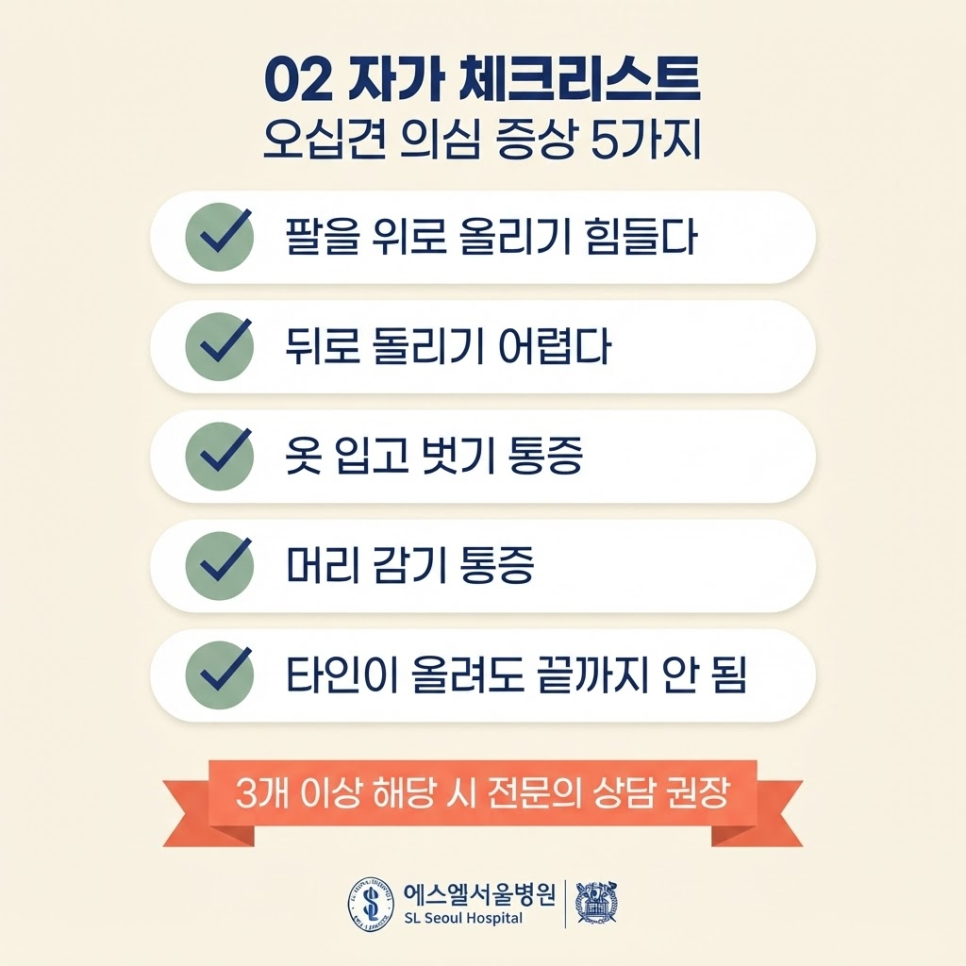
    Symptom Checklist
    ✅ Difficulty lifting your arm overhead or rotating it behind your back
    ✅ Pain when getting dressed or washing your hair
    ✅ Pain that radiates from the shoulder down to the elbow
    ✅ Trouble sleeping when lying on the affected side
    ✅ Your arm still won’t lift all the way even when a family member or someone else raises it for you

    frozen shoulder treatment illustration 6


    What Causes Frozen Shoulder?

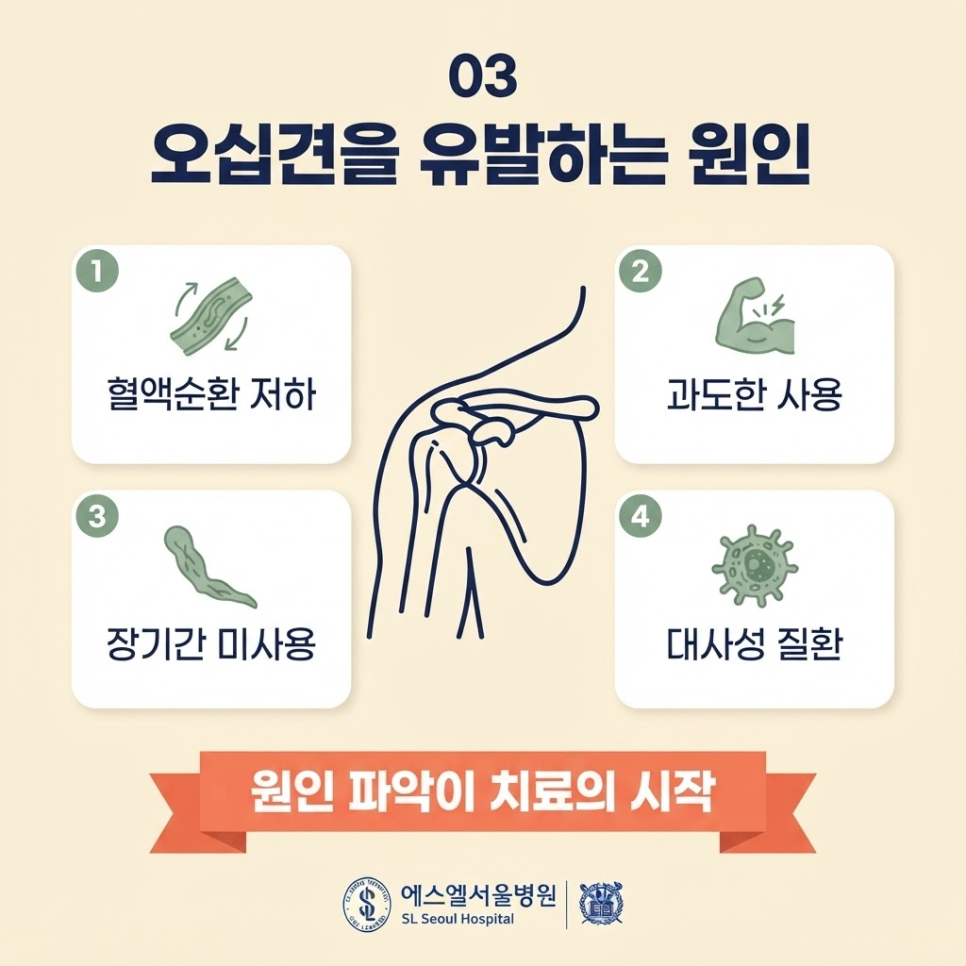
    The main causes of frozen shoulder are reduced blood flow around the joint and an inflammatory response.

    The joint capsule can stiffen from overusing the shoulder — or, just as often, from not moving it enough over a long stretch of time.

    Age-related degenerative changes are also a major factor,
    and some reports suggest that metabolic conditions such as diabetes or thyroid disease can raise the risk of developing frozen shoulder.
    One orthopedic specialist has noted that having diabetes may raise the risk of frozen shoulder by more than fivefold.

    frozen shoulder treatment illustration 7


    How Is Frozen Shoulder Treatment Done?

    Frozen shoulder treatment approaches differ depending on the pain stage.

    During the acute phase, when pain is at its worst, calming the inflammation comes first. Once pain eases into the chronic phase, exercises to loosen the stiffened joint can begin.

    To pinpoint the correct stage, a doctor will first assess the pain pattern,
    and imaging may be used if needed to check the extent of adhesions inside the joint.
    Treatment typically follows each stage in order, with exercises kept within a comfortable, non-strenuous range.

    frozen shoulder treatment illustration 8

    Caution
    Forcing a stretch past the point of pain can actually make the inflammation worse.
    The general rule is to move gently only up to just before pain begins.
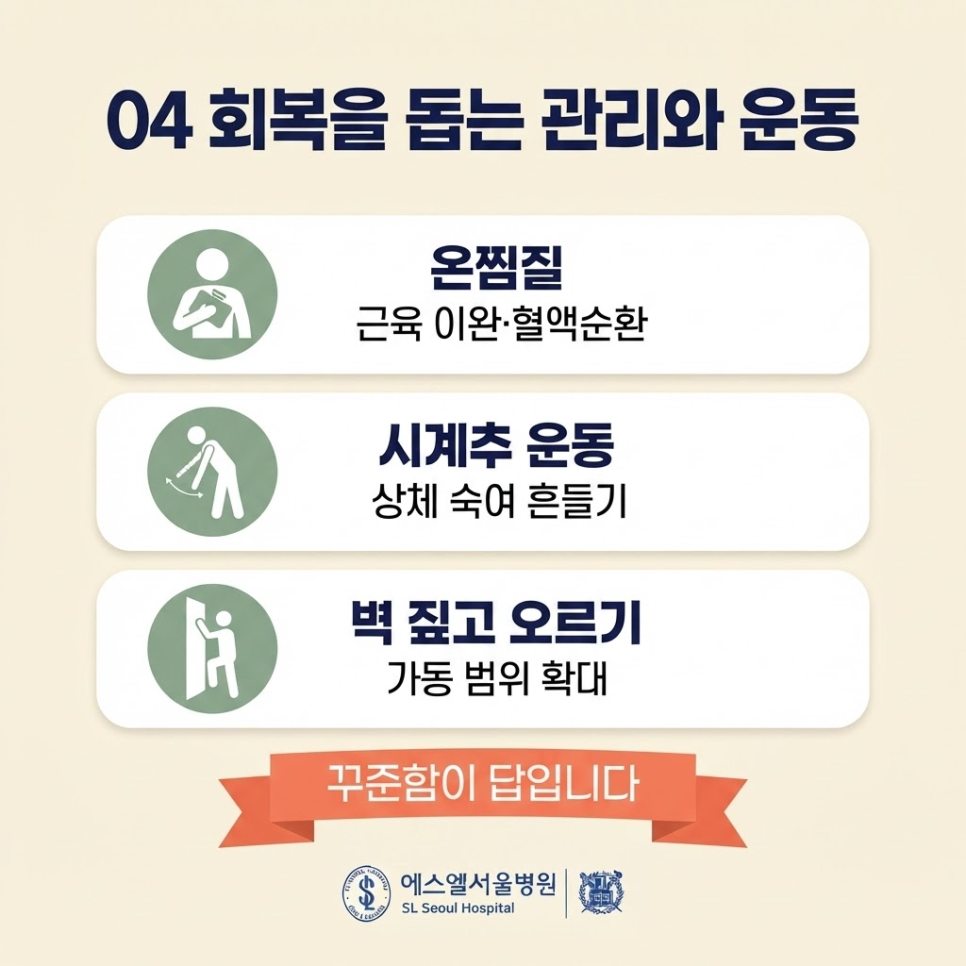
    1. Warm compress: Helps relax muscle tension and supports blood circulation.
    2. Pendulum exercise: Gently hold the affected arm with your unaffected hand, lean your upper body forward, and let the arm swing slowly like a pendulum.
    3. Wall climb (finger walk): Face a wall and slowly walk your fingers upward, gradually increasing your range of motion.
    What to Expect
    With consistent, stage-appropriate management, shoulder range of motion tends to gradually improve over time.
    Recovery speed varies from person to person, though, and can typically take anywhere from several months to one or two years.

    If it’s hard to judge the exact cause and stage on your own,
    we recommend having a specialist evaluate your current condition first.
    You can find related care information on the SLS Seoul Hospital Spine & Joint Center homepage.


    Frequently Asked Questions

    1. Does frozen shoulder go away on its own?
    Some cases do ease with time, but if left untreated, the shoulder can stiffen with reduced function or develop additional pain, so consulting a specialist is recommended.

    2. Is more exercise always better?
    No. Forcing your range of motion past the point of pain can make the inflammation worse. The key is to move within a controlled range and stop just before pain sets in.

    3. How is frozen shoulder treatment carried out at a hospital?
    Since shoulder pain can have many different causes, exercising on your own without an accurate diagnosis can make things worse. It’s safer to have an orthopedic specialist assess the pain pattern — and imaging, if needed — before setting a treatment plan.

    4. Can you tell frozen shoulder and a rotator cuff tear apart at home?
    If your arm still won’t lift all the way even when someone else raises it for you, frozen shoulder is more likely, but imaging is needed for an accurate diagnosis.


    SLS Seoul Hospital supports patients with accurate diagnosis and stage-by-stage management of shoulder pain.

    frozen shoulder treatment illustration 9

    frozen shoulder treatment illustration 10

    frozen shoulder treatment illustration 11

    frozen shoulder treatment illustration 12

    frozen shoulder treatment illustration 13

    frozen shoulder treatment illustration 14


    References

    · Korea Disease Control and Prevention Agency, “Frozen Shoulder (Adhesive Capsulitis),” National Health Information Portal. View source
    · Asan Medical Center Newsroom, “Exercises for Frozen Shoulder Treatment,” Asan Medical Center. View source
    · MediPana, “Frozen Shoulder Linked to Diabetes and Thyroid Disease — Caution Advised for Those 40 and Older,” MediPana News. View source
    · Hankook Ilbo, “Leaving Frozen Shoulder Untreated Can Lead to Chronic Pain — Treatments That Shorten Recovery Time,” Hankook Ilbo, 2025. View source


    This article is intended to provide general health information and is not a substitute for individual diagnosis or treatment.
    If you have symptoms, please consult a specialist.

  • Carpal Tunnel Syndrome Self-Test: 5 Signs to Watch For

    Carpal Tunnel Syndrome Self-Test: 5 Signs to Watch For

    SummaryCarpal tunnel syndrome occurs when the carpal tunnel narrows and compresses the median nerve, causing pain and numbness. This guide covers a carpal tunnel syndrome self-test checklist, diagnostic methods like Tinel’s sign and Phalen’s test, treatment timing, and when to see an orthopedic doctor. It also looks at the common causes of wrist numbness.

    Many people worry that wrist numbness will eventually lead to surgery,
    and that fear alone keeps them from seeing a doctor.

    In reality, though, it’s often the opposite.
    In the early or moderate stages, medication and physical therapy alone are often enough to bring improvement.

    Ignoring carpal tunnel syndrome is actually the far riskier choice.

    This article covers the causes of carpal tunnel syndrome, a carpal tunnel syndrome self-test checklist, the exams performed at an orthopedic clinic, and stretches you can do at home to protect your wrists.
    Let’s look at what signs suggest it’s time to see a doctor when wrist numbness lingers.

    Carpal Tunnel Syndrome Self-Test Basics: What Exactly Is This Condition?

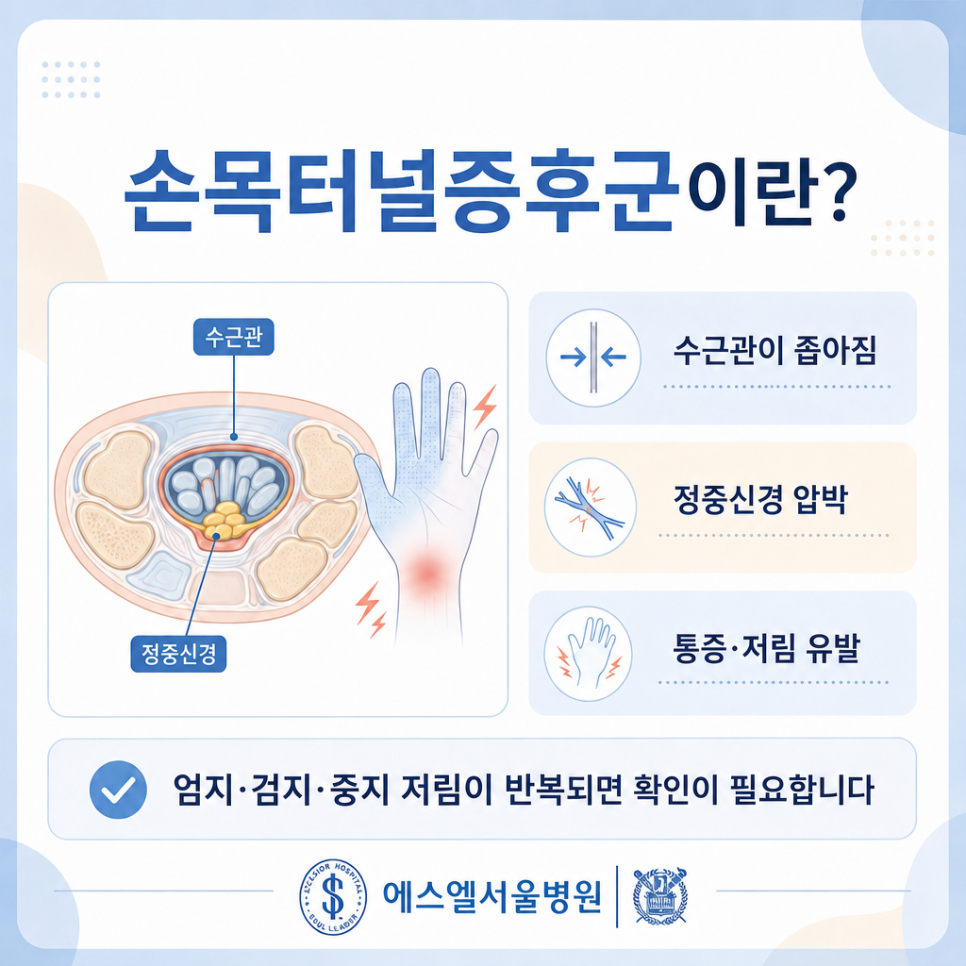
    Carpal tunnel syndrome is a condition in which the carpal tunnel, a narrow passage on the inside of the wrist, becomes compressed and puts pressure on the median nerve, causing pain and numbness.
    It’s also commonly referred to as median nerve compression, and a simple carpal tunnel syndrome self-test can help you spot it early.

    Carpal tunnel syndrome self-test illustration

    With how often we use computer keyboards and smartphones these days, this is a genuinely common symptom.

    Brushing off a tingling fingertip as nothing serious can end up making the treatment period longer instead of shorter.

    If it’s dismissed as ordinary fatigue and left alone, the nerve can stay compressed long enough for sensation to become dulled.
    If your job involves repetitive wrist movements, it’s worth paying a little extra attention.

    Carpal tunnel syndrome related image 2

    The Areas the Median Nerve Controls

    Key Point
    The median nerve controls sensation in the thumb, index finger, middle finger, and half of the ring finger.
    If tingling is especially noticeable in these areas, it may be worth considering whether the carpal tunnel is compressed.

    How Do You Do a Carpal Tunnel Syndrome Self-Test? 5 Early Symptoms to Check

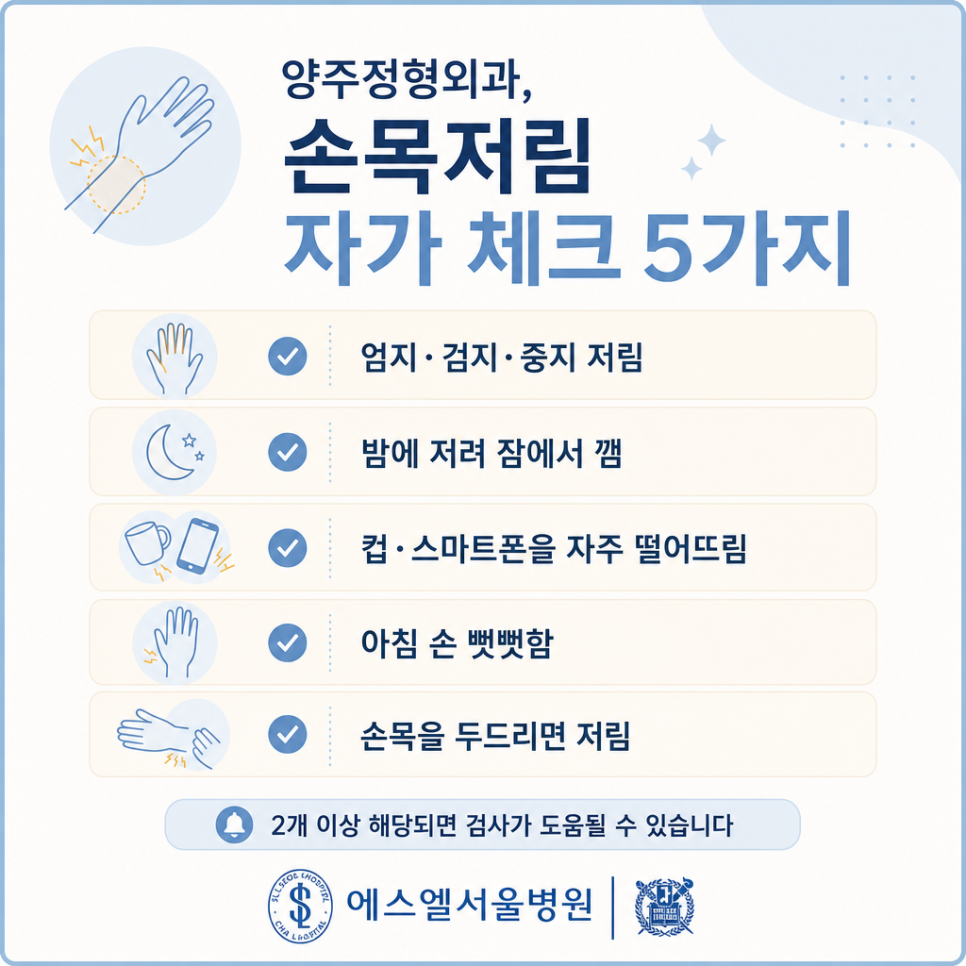
    If two or more of the five items in this carpal tunnel syndrome self-test apply to you, it’s a good idea to get examined.
    Go through them one by one below.

    Carpal tunnel syndrome related image 3

    Carpal Tunnel Syndrome Self-Test Checklist
    ✅ The tips of your thumb, index, and middle fingers feel tingly or numb
    ✅ You often wake up at night because your hand feels numb
    ✅ You’ve dropped a cup or your phone without meaning to
    ✅ Your hand feels stiff in the morning
    ✅ Tapping the inside of your wrist sends a tingling feeling outward

    Carpal tunnel syndrome related image 4

    Why a Carpal Tunnel Syndrome Self-Test Matters: Common Contributing Habits

    Overusing the wrist with repetitive motion, housework, and long hours on a smartphone are among the most common causes.

    It tends to show up especially often in jobs that involve working with the wrist bent for long stretches.
    Women, as well as people with diabetes or thyroid conditions, may also be relatively more prone to it.

    Carpal tunnel syndrome related image 5

    Caution
    The longer symptoms go untreated, the greater the risk of thumb muscle atrophy and permanent nerve damage.
    If numbness keeps recurring, it’s best not to put off getting checked.

    After a Carpal Tunnel Syndrome Self-Test: How Are Orthopedic Exams and Treatment Carried Out?

    If symptoms keep coming back, it’s a good idea not to just tough it out, especially when a carpal tunnel syndrome self-test raises concern, and instead get a thorough exam at an orthopedic clinic.
    Depending on your symptoms and condition, the exams below are typically carried out step by step.

    Carpal tunnel syndrome related image 6

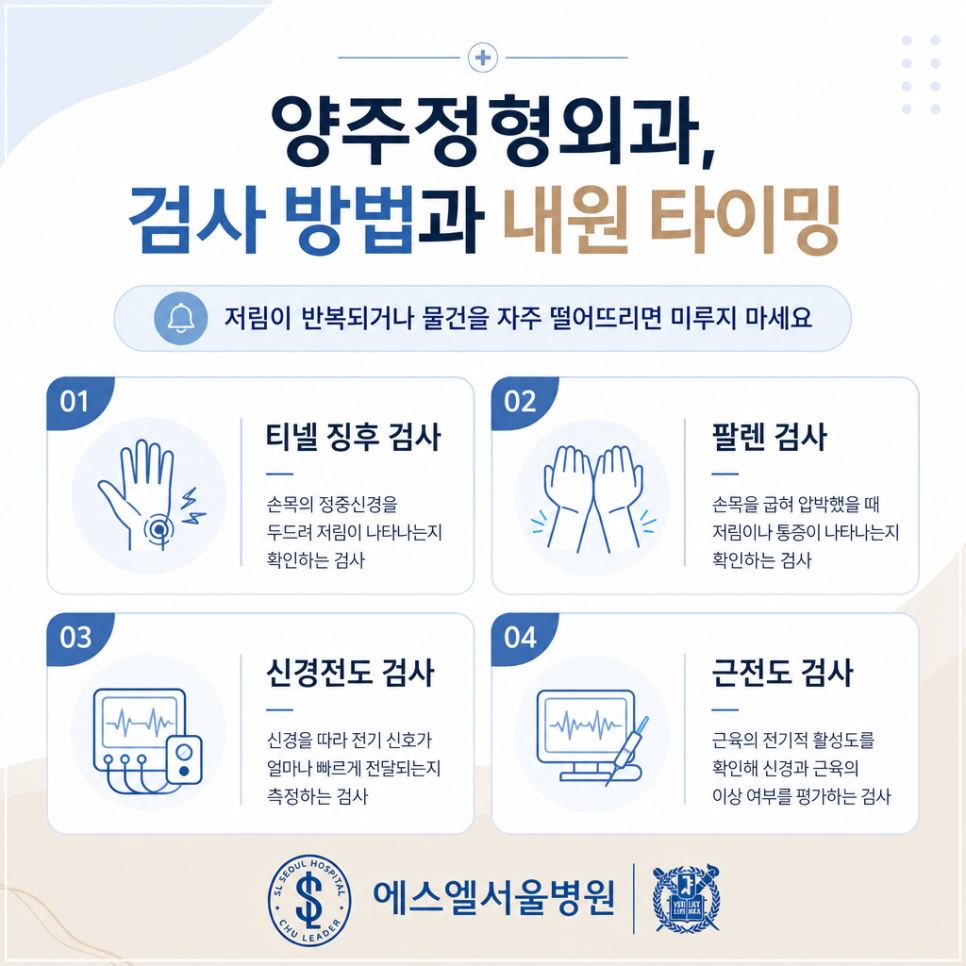
    Test Method Purpose
    Tinel’s Sign Test Gently tapping the inside of the wrist Checks for a median nerve stimulation response
    Phalen’s Test Holding the wrist bent for about one minute Checks whether numbness is triggered
    Nerve Conduction / EMG Study Measuring the nerve’s response to electrical stimulation Evaluates the degree of nerve damage in detail
    Key Point
    When caught early, non-surgical options such as medication, physical therapy, or injection therapy are often enough to bring improvement.
    Checking the extent of nerve damage through testing comes first.

    Carpal tunnel syndrome related image 7

    If you’d like more information on diagnosis and treatment options, you can find details on the clinic page at SL Seoul Spine & Joint Hospital.


    How Can You Protect Your Wrists in Daily Life?

    Simply keeping up good daily habits can help ease symptoms.
    The key is reducing the strain placed on your wrists.

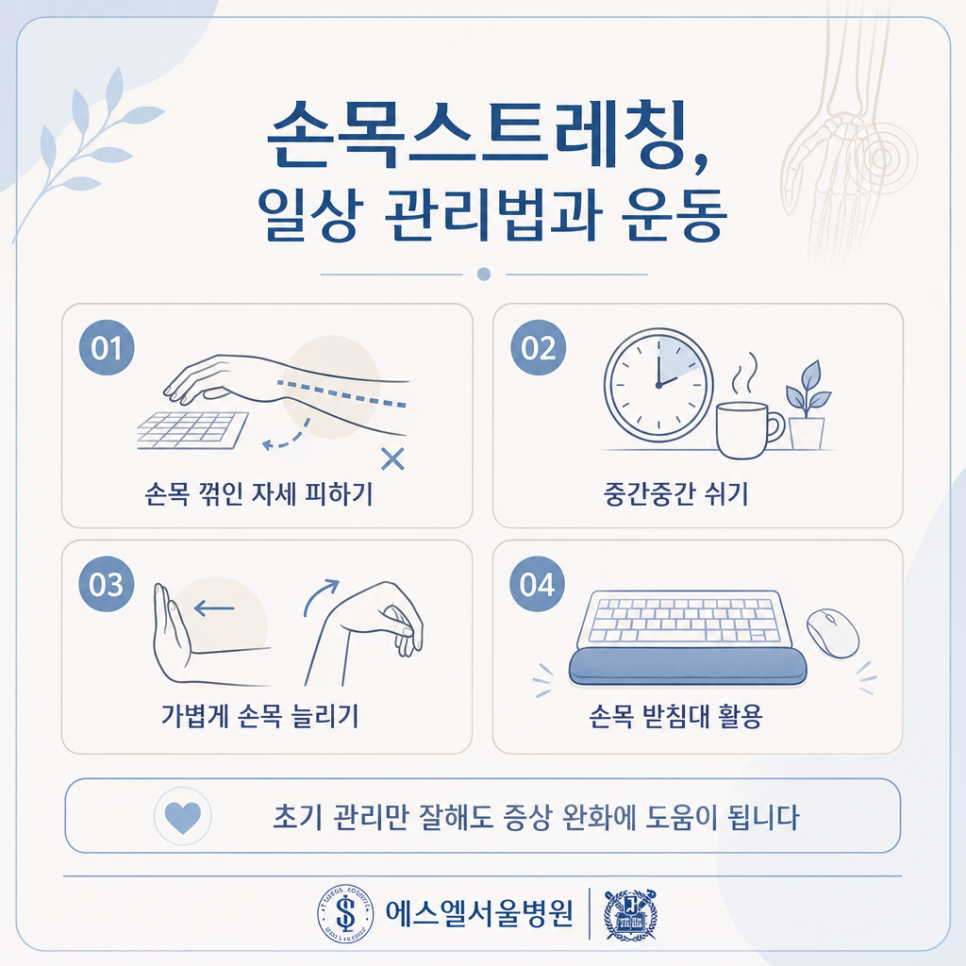
    When using a mouse or keyboard, use a wrist rest to keep your wrist from bending, and check your monitor height and chair position as well.

    Carpal tunnel syndrome related image 8

    4-Step Wrist Stretch

    1. Extend your arm straight out in front of you.
    2. Bend your wrist so your fingertips point toward the floor.
    3. With your other hand, gently pull the back of your hand and hold for about 15 seconds.
    4. Repeat 3 to 5 times on each wrist.
    Result
    Consistent stretching can help lower pressure inside the carpal tunnel and loosen tight ligaments and muscles.

    For anyone curious about the treatment environment, here are a few photos of the clinic space.

    Carpal tunnel syndrome related image 9

    Carpal tunnel syndrome related image 10

    Carpal tunnel syndrome related image 11

    Carpal tunnel syndrome related image 12

    Carpal tunnel syndrome related image 13

    Carpal tunnel syndrome related image 14


    Frequently Asked Questions About the Carpal Tunnel Syndrome Self-Test

    1. Does wrist numbness always mean I’ll need surgery?
    Not necessarily. In the early or moderate stages, non-surgical options like physical therapy or injection therapy can often bring enough improvement.

    2. Does applying heat at home help?
    Heat can help with everyday stiffness, while a cold compress may help more when pain and swelling are severe.

    3. What should I watch out for to help prevent it?
    Avoid working with your wrist bent for long stretches, use a wrist rest when using a mouse or keyboard, and repeat a carpal tunnel syndrome self-test regularly to catch changes early.

    4. How long does recovery take?
    It varies from person to person, but consistent management often leads to improvement over time.

    5. Can carpal tunnel syndrome come back?
    If repetitive strain on the wrist continues, it can recur, which is why managing your posture and habits going forward matters.

    Carpal tunnel syndrome related image 15

    Carpal tunnel syndrome related image 16

    Carpal tunnel syndrome related image 17

    Carpal tunnel syndrome related image 18


    References

    · Korea Disease Control and Prevention Agency, “Carpal Tunnel Syndrome,” National Health Information Portal. View source
    · Asan Medical Center, “Carpal Tunnel Syndrome,” Disease Encyclopedia. View source

    This article is intended for general health information purposes only and is not a substitute for individual diagnosis or treatment. If you have symptoms, please consult a physician.
  • Wrist Tenosynovitis Self-Check: 4 Signs From Pocheon Orthopedic Clinic

    Wrist Tenosynovitis Self-Check: 4 Signs From Pocheon Orthopedic Clinic

    SummaryIf you feel a sharp, stinging pain every time you bend your wrist, start with this wrist tenosynovitis self-check checklist. Pocheon Orthopedic Clinic breaks down the causes and symptoms of De Quervain’s disease, how it’s diagnosed, and the lifestyle habits that can help shorten recovery time.

    Do you feel a sharp, stinging pain every time you bend your wrist?
    Many people assume it’s just from overusing their hands and brush it off.

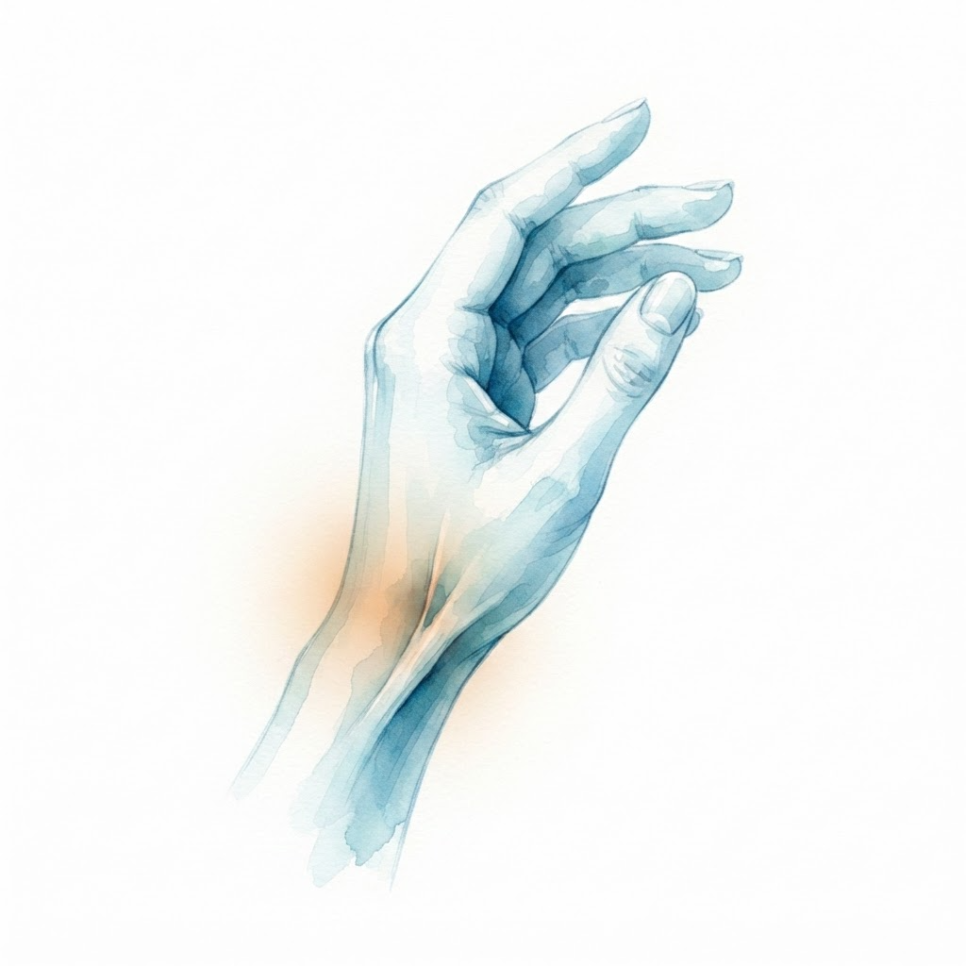
    That pain could actually be wrist tenosynovitis — inflammation of the tissue surrounding the wrist tendons.
    Left unaddressed, it can become chronic and take months to recover from.

    Below, we’ll walk through a wrist tenosynovitis self-check checklist and the signs that mean it’s time to see a doctor.

    wrist tenosynovitis self-check

    Key Points
    · We break down the causes and key symptoms of wrist tenosynovitis (De Quervain’s disease).
    · We introduce a wrist tenosynovitis self-check you can try at home right now.
    · We cover the lifestyle habits that can help speed recovery and when to see a doctor.

    wrist tenosynovitis self-check - related image 2

    What Is Wrist Tenosynovitis?

    Put simply, wrist tenosynovitis is inflammation of the sheath surrounding the tendon that runs to the thumb.
    Medically, it’s known by its official name, De Quervain’s disease.

    It tends to show up in people who use their wrists repetitively.
    Pain begins when the tendons that move the thumb pass through a narrow tunnel and repeated friction builds up over time.

    According to medical information from Seoul Asan Hospital, it’s especially common among office workers who use smartphones or computers heavily, as well as homemakers who do repetitive housework.
    It often starts as mild discomfort, but if left unaddressed it can seriously disrupt daily life, which is why early attention matters.

    wrist tenosynovitis self-check - related image 3


    How Can You Self-Check for Wrist Tenosynovitis at Home?

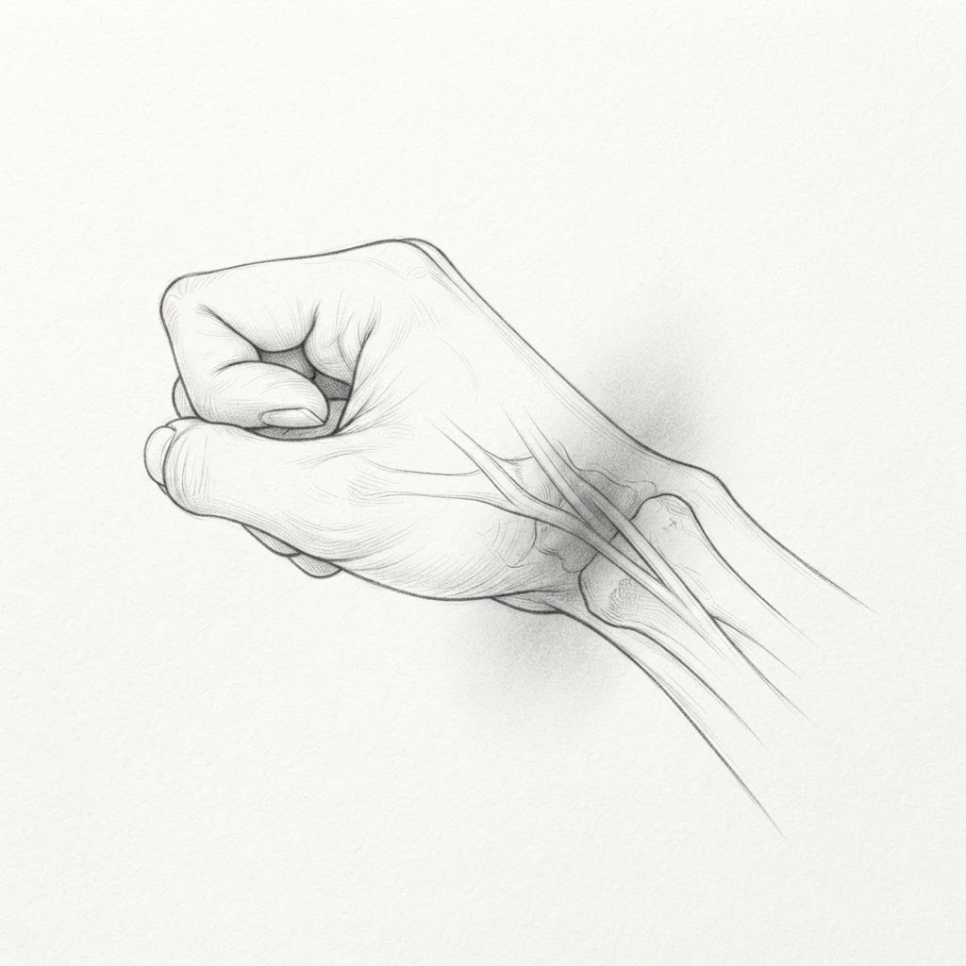
    The simplest method is a self-test known as the Finkelstein test.
    Fold your thumb into your palm, wrap your other four fingers around it to make a fist, then slowly bend your wrist toward your little finger.

    If this brings on sharp pain or a tingling, radiating sensation, wrist tenosynovitis may be the cause.
    Check the list below for other signs to watch for.

    Checklist
    ✅ Pain in the wrist area connecting to the thumb
    ✅ A sharp, stinging feeling when gripping or holding objects
    ✅ A creaking or grinding sensation when moving the wrist
    ✅ Wrist stiffness first thing in the morning

    If two or more of these apply to you, it may be an early sign of tenosynovitis rather than simple fatigue.
    It’s common for people to brush this off at first, only to end up seeing a doctor weeks later once the pain has worsened.

    wrist tenosynovitis self-check - related image 4


    Why Does Wrist Tenosynovitis Happen?

    In short, repetitive overuse of the wrist is the leading cause.
    It’s not a single motion but the same motion repeated over and over that increases friction between the tendon and its surrounding sheath.

    Cause Type Common Examples
    Device overuse Prolonged smartphone or computer use
    Repetitive labor Housework or jobs requiring heavy wrist use
    Poor posture Working for long periods with the wrist bent

    Some reports suggest it occurs more often in women.
    Perhaps because of this, it tends to appear more frequently among those who primarily handle childcare or housework.

    wrist tenosynovitis self-check - related image 5


    How Do Doctors Diagnose and Treat It?

    If your self-check raises concern, it’s best to get an accurate diagnosis at an orthopedic clinic.
    A physical exam combined with an ultrasound can help confirm how inflamed the tendon sheath is.

    wrist tenosynovitis self-check - related image 6

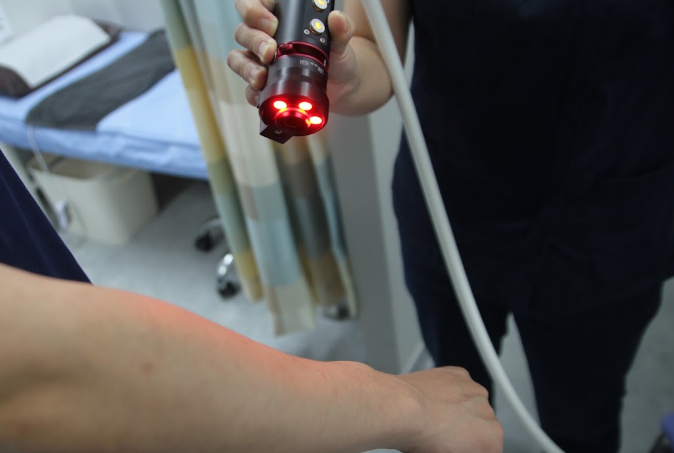
    In the early stages, adequate rest is often combined with physical therapy.
    Depending on the case, medication or injections may also be used to help reduce inflammation.

    That said, treatment outcomes can vary depending on the severity of symptoms and individual lifestyle habits.
    For an accurate assessment and treatment plan, we recommend reviewing the care information on the SL Seoul Hospital for Spine & Joints homepage before scheduling an in-person consultation.


    What Habits Help Shorten Recovery Time?

    Recovery time varies significantly depending on how far the condition has progressed and how well it’s managed.
    Mild cases often improve within a few weeks, but if left unaddressed, it can turn chronic and take several months or longer.

    wrist tenosynovitis self-check - related image 7

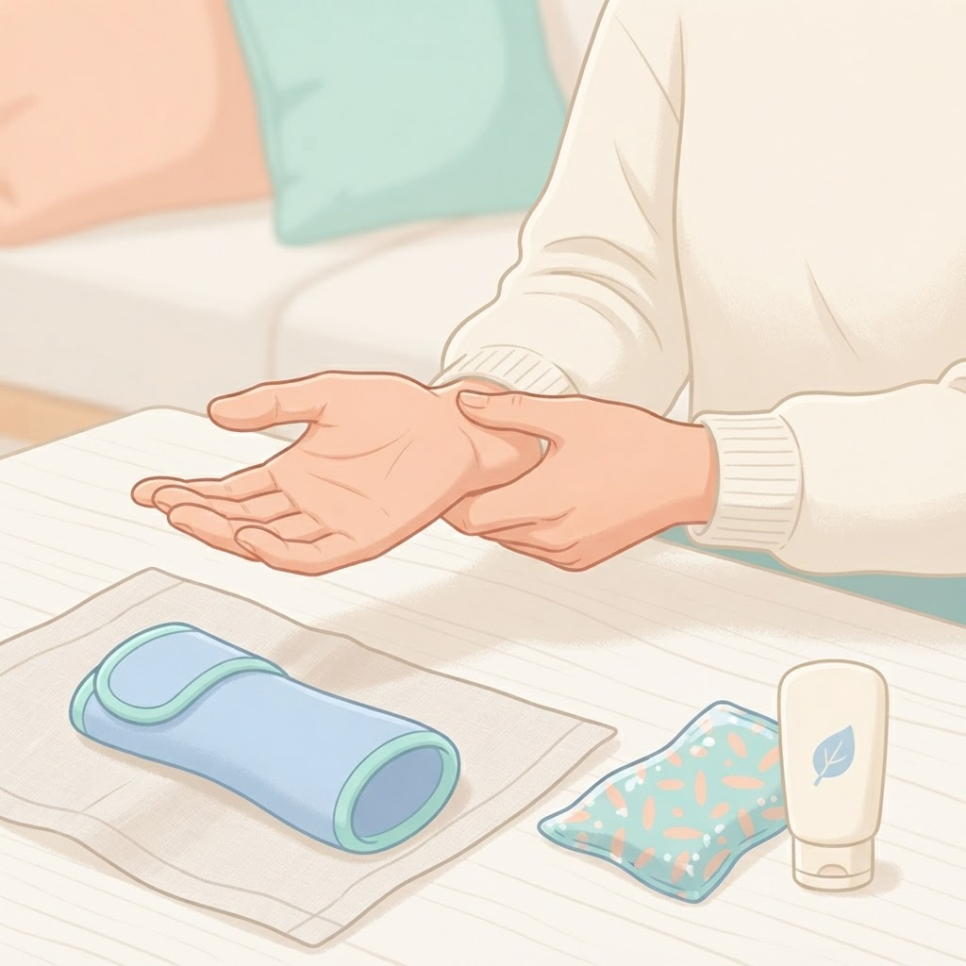
    How to Use Heat, Ice, and Stretching

    Situation Recommended Care
    Acute phase with severe pain Cold compress
    Chronic phase with lingering stiffness Warm compress

    For stretching, extend your arm forward, point your fingers downward, and gently pull them back with your other hand.
    When working, wear a wrist brace to help keep the joint from bending too far.

    wrist tenosynovitis self-check - related image 8

    Takeaway
    Combining rest, compresses, and stretching from the earliest stage of symptoms may help prevent the condition from turning chronic.

    When using your smartphone for long stretches, be sure to give your wrist regular breaks.
    Simply avoiding movements that strain the wrist can help with prevention.

    wrist tenosynovitis self-check - related image 9

    Caution
    Pushing through the pain and continuing to use your wrist is a common reason recovery gets delayed.
    If discomfort lasts more than a few days, don’t put it off — get it checked at a medical facility.

    wrist tenosynovitis self-check - related image 10


    Frequently Asked Questions

    1. Will it heal on its own if I just use a pain-relief patch?
    That may help relieve pain temporarily, but if the underlying cause of the inflammation isn’t addressed, it can easily come back.

    2. What kind of compress should I use?
    Cold compresses can help when there’s heat or swelling, while warm compresses tend to work better for a heavy, achy feeling.

    3. Do I really need to wear a wrist brace?
    Wearing one during work or housework that puts heavy strain on your wrist can help reduce stress on the joint.

    4. Is there a clear sign that means I should see a doctor?
    If the pain lasts more than a few days or it becomes hard to grip objects, it’s safer to visit a clinic for a thorough evaluation.

    5. If my wrist tenosynovitis self-check raises concerns, do I need surgery right away?
    Rest, physical therapy, and medication are generally used as initial treatment, and surgery is typically considered only when symptoms persist over the long term.

    wrist tenosynovitis self-check - related image 11


    References

    · Seoul Asan Hospital, “De Quervain’s Disease,” Easy Medical Terms. View
    · Mayo Clinic Staff, “De Quervain tenosynovitis – Diagnosis and treatment,” Mayo Clinic. View
    · “Management of de Quervain Tenosynovitis,” PMC, National Library of Medicine. View

    wrist tenosynovitis self-check - related image 12

    wrist tenosynovitis self-check - related image 13

    wrist tenosynovitis self-check - related image 14


    This article is intended for general health information purposes only and is not a substitute for individual diagnosis or treatment.
    If you’re experiencing symptoms, please consult a medical professional.

  • Fallen Arch Symptoms: 4 Warning Signs and a Shoe Sole Self-Check

    Fallen Arch Symptoms: 4 Warning Signs and a Shoe Sole Self-Check

    SummaryIf one side of your shoe sole is noticeably more worn than the other, it may point to fallen arch symptoms. This guide walks through the four most common warning signs — from your feet to your calves, knees, and lower back — along with an at-home footprint self-check and practical ways to manage the condition.

    Have you ever flipped your shoes over to check the soles?

    If the inside edge is noticeably more worn than the rest, it could be a sign of fallen arch symptoms.

    That uneven wear pattern can mean your body weight is shifting toward one side of your foot.

    If you’ve had unexplained tightness in your feet, calves, knees, or lower back, this could be the reason.

    fallen arch symptoms

    In this article, we’ll look at why the foot arch can collapse and cover the four main warning signs.

    We’ll also walk through shoe sole wear patterns, an at-home footprint self-check, and everyday habits that may help.

    illustration related to fallen arch symptoms 2

    What Are Fallen Arch Symptoms?

    Fallen arch symptoms refer to the curved structure on the inside of the foot flattening out over time.

    With every step, the foot’s arch helps absorb the impact of hitting the ground.

    When that curved structure collapses, shock absorption drops off sharply.

    illustration related to fallen arch symptoms 3

    With each step, the ankles and knees end up absorbing more of that impact directly.

    As a result, fatigue can build up not just in the soles of the feet but also in the calves and lower back.

    If this continues over time, it may also start to affect the muscles around the inner knee or pelvis.

    Flat feet are generally described as a condition where the foot’s arch sits lower than normal.

    illustration related to fallen arch symptoms 4

    Key Points
    ✔ The arch of the foot is a key structure for distributing body weight.
    ✔ When it collapses, strain on the ankles, knees, and lower back can increase.

    What Signs Can Your Shoes and Pain Reveal?

    There are four common signs that your foot arch may be collapsing.

    If the inside of your sole feels a sharp twinge even after walking a short distance, it’s worth paying closer attention.

    Checking the wear pattern on your shoe heels is another useful way to check.

    illustration related to fallen arch symptoms 5

    If the inner edge of your shoe sole is noticeably more worn than the rest,
    it’s a sign that your weight is shifting inward.

    A sharp pain in the heel with your first steps in the morning is another common sign.

    This kind of pain often results from repeated strain on the plantar fascia.

    If these signs are ignored and you keep walking on it, the area of discomfort can gradually spread.

    illustration related to fallen arch symptoms 6

    Checklist
    ✅ The soles of your feet feel heavy or sore even without much walking
    ✅ The inner sole of your shoes or sneakers wears out noticeably fast
    ✅ Your ankle feels like it’s rolling or collapsing inward
    ✅ Your sole feels a sharp twinge when you start walking in the morning

    How Can You Self-Check Your Arch at Home?

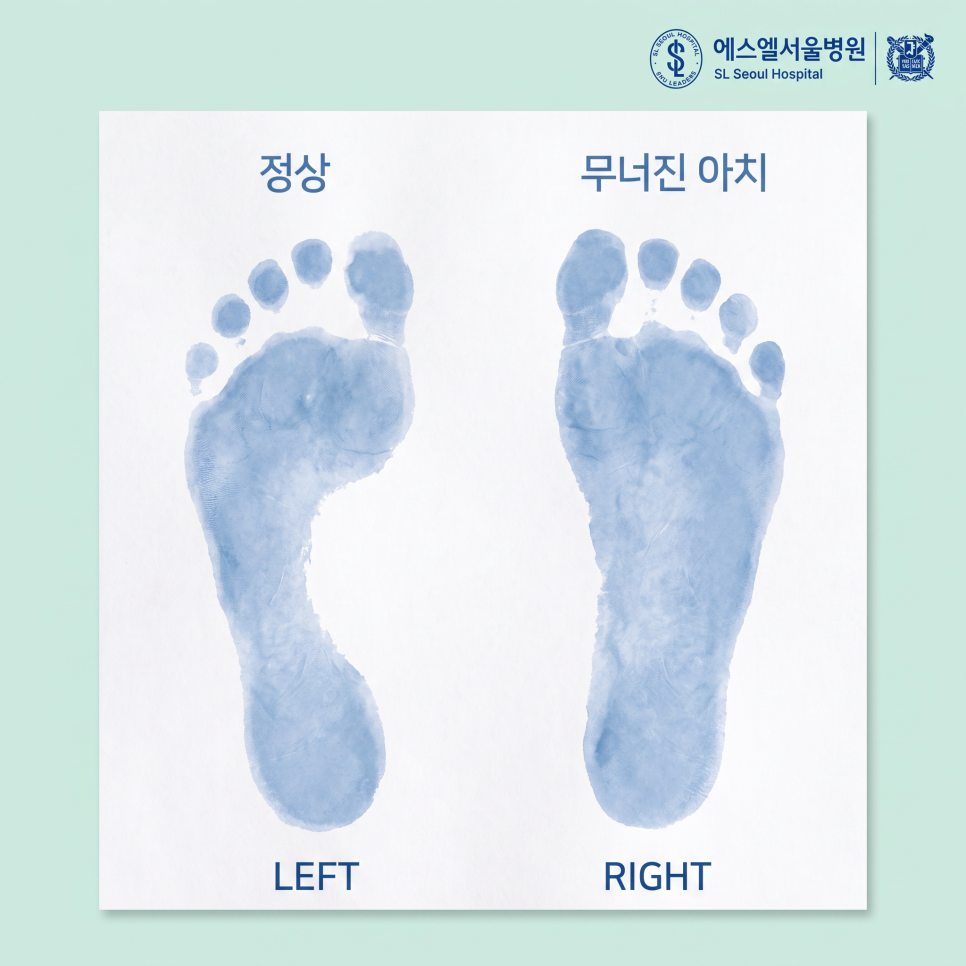
    A footprint test is a self-check method where you wet the sole of your foot and press it onto paper to see the shape of your arch.

    It’s a simple way to get a rough sense of your foot condition before seeing a doctor.

    1. Fill a basin with water and thoroughly wet the soles of your feet.
    2. Step naturally onto a dry towel or a sheet of paper.
    3. Lift your foot and check the shape of the inner portion of the footprint left behind.

    illustration related to fallen arch symptoms 7

    Footprint Shape What It May Indicate
    A clear, narrow gap on the inner edge Typical arch shape
    The inner edge is fully filled in May suggest a fallen arch; consulting a specialist is recommended
    Result
    Check whether the inner, waist-like portion of the footprint shows a clear narrow gap.
    If it’s completely filled in, it’s a good idea to consider seeing a specialist for further evaluation.

    This self-check is meant for reference only —
    for an accurate assessment, it’s best to see a specialist.


    How Should You Manage a Fallen Arch?

    Fully reversing an already-collapsed arch structure isn’t easy.

    However, small changes to daily habits may help slow its progression.

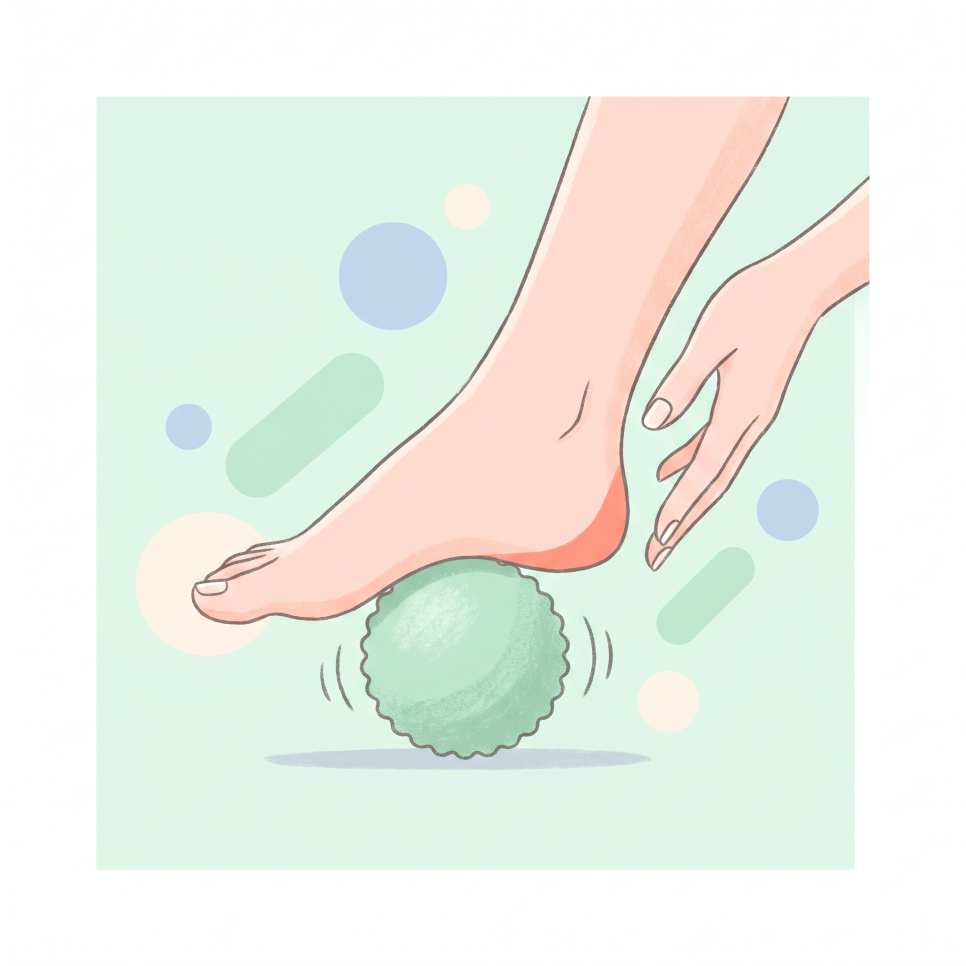
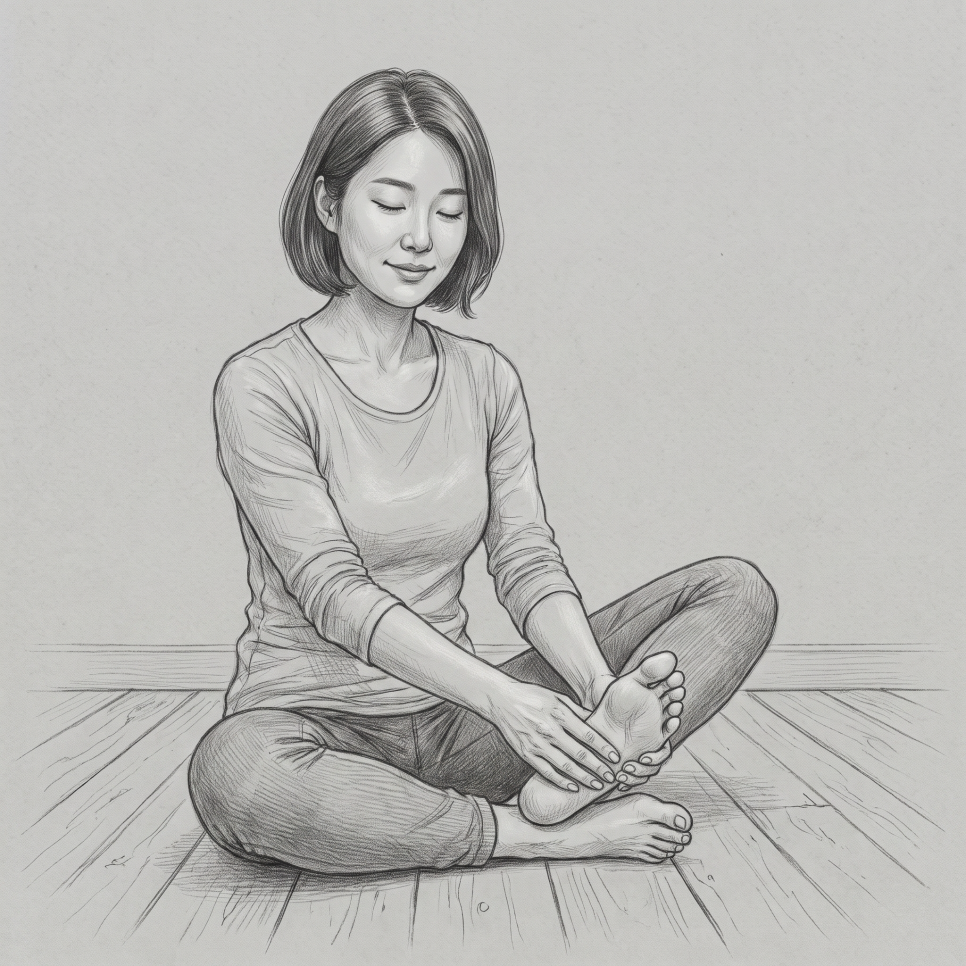
    Gently massaging the muscles in the sole of the foot can be a helpful part of this.

    illustration related to fallen arch symptoms 8

    Placing a small ball under your foot and rolling it gently may help ease fatigue.

    It’s also best to avoid shoes with an overly stiff sole or no heel support at all.

    Picking up a towel with your toes for about 5 minutes a day is another exercise worth trying consistently.

    Caution
    Walking barefoot on hard surfaces for extended periods can actually place more strain on your feet.
    If pain persists or worsens, consulting a specialist should take priority over self-care alone.

    If you suspect fallen arch symptoms, it’s best not to ignore them and to get checked instead.

    If your self-check results are unclear or the pain continues, it’s advisable to get a thorough evaluation rather than guessing on your own.

    SL Seoul Hospital (Spine & Joint) home offers evaluations that look at how your foot, knee, and lower back conditions may be connected.


    Frequently Asked Questions

    1. If my foot structure has collapsed, will I definitely need surgery?
    If it’s in an early stage or isn’t significantly affecting daily life, it can often be managed with supportive devices or exercise.

    2. What kind of shoes can help?
    Cushioned shoes that absorb impact well and offer moderate arch support are a good choice.

    3. Is it okay to walk barefoot often?
    Walking barefoot on hard surfaces for long periods can place extra strain on your feet, so caution is advised.

    4. Are there simple exercises I can do at home?
    Picking up a towel with your toes or doing regular sole stretches can help.

    illustration related to fallen arch symptoms 9


    References

    · Asan Medical Center, “Plantar Fasciitis,” Disease Encyclopedia, 2026. View source
    · Seoul National University Hospital, “Flat Feet (Pes Planus),” Medical Information, 2026. View source
    · Hidoc, “‘Huh? It Wasn’t Like This Before’ — The Sudden Onset of Adult-Acquired Flat Foot,” Hidoc Health Talk, 2026. View source


    This article is provided for general health information purposes only and is not a substitute for individual diagnosis or treatment.
    If you’re experiencing symptoms, please consult a specialist.

  • Car Accident Aftereffects: 3 Signs You Need a Dongducheon Orthopedic Exam

    Car Accident Aftereffects: 3 Signs You Need a Dongducheon Orthopedic Exam

    SummaryCar accident aftereffects can appear as neck and shoulder pain or hand tingling even when X-rays come back normal. This guide covers the causes and symptoms of whiplash injury, when to visit a Dongducheon orthopedic clinic, what a detailed exam involves, and daily habits that may support recovery.

    You felt fine right after the accident,
    but a few days later your neck feels stiff and your fingertips start to tingle.

    Even when you get an X-ray at the hospital, car accident aftereffects often don’t show up on bone imaging alone.
    That’s because subtle damage to muscles, ligaments, and nerves doesn’t appear on film.

    If a normal X-ray has made you hesitate to get checked out of fear it’s an overreaction, the information below may help.

    💡 Article Preview
    · We explain why car accident aftereffects don’t show up on X-rays, and how whiplash injury actually happens.
    · We cover exactly when to visit a Dongducheon orthopedic clinic and what a detailed exam typically involves.
    · We also go over daily habits that may support recovery and precautions worth keeping in mind.

    car accident aftereffects

    What Are Car Accident Aftereffects?

    Car accident aftereffects refer to delayed pain that shows up after tissue in the body is subtly damaged by the impact of a collision, often not appearing until some time has passed.

    At the moment of impact, stress hormones like adrenaline are released, which can temporarily dull pain.
    That’s why many people feel fine immediately after a crash.

    But once the body relaxes over the following days, damage to muscles and ligaments can gradually surface as pain.

    car accident aftereffects — related image 3

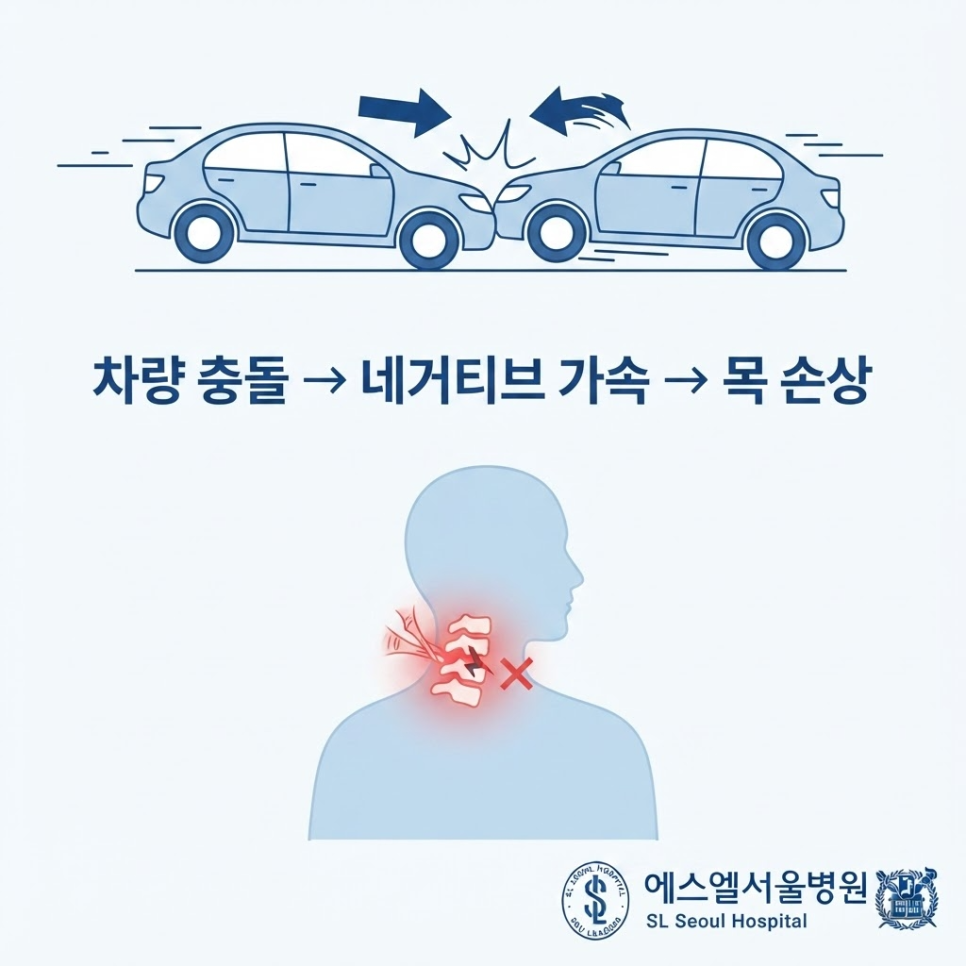
    At the moment a vehicle collides, the body undergoes sudden acceleration and deceleration at the same time.
    The neck snaps forcefully back and forth, and the ligaments and muscles around the cervical spine can stretch or tear — a pattern known as whiplash injury.

    The name comes from the whip-like motion of the neck, and whiplash injuries of this kind are commonly associated with car accidents.
    This is why patients can feel severe pain even when an X-ray shows no problem with the bones themselves.

    🎯 Key Point
    If mistaken for a simple bruise and left unaddressed, whiplash may progress into chronic neck, shoulder, and back pain, along with headaches and dizziness.

    When Should You Visit a Dongducheon Orthopedic Clinic?

    Because symptoms often appear days after the accident rather than right away, many people miss the right time to get checked.

    So what specific signs mean it’s time to visit a specialized medical center such as a Dongducheon orthopedic clinic?

    car accident aftereffects — related image 4

    If stiffness and tightness in your neck and shoulders continue for several days, it’s best not to put off a visit.
    The same goes for tingling in your hands or feet, or unexplained heaviness in your back.

    If nausea, insomnia, or unexplained fatigue show up alongside these symptoms, nerve damage should also be considered.
    If even one of these signs sounds familiar, it’s wise to see a medical professional rather than wait it out.

    car accident aftereffects — related image 5

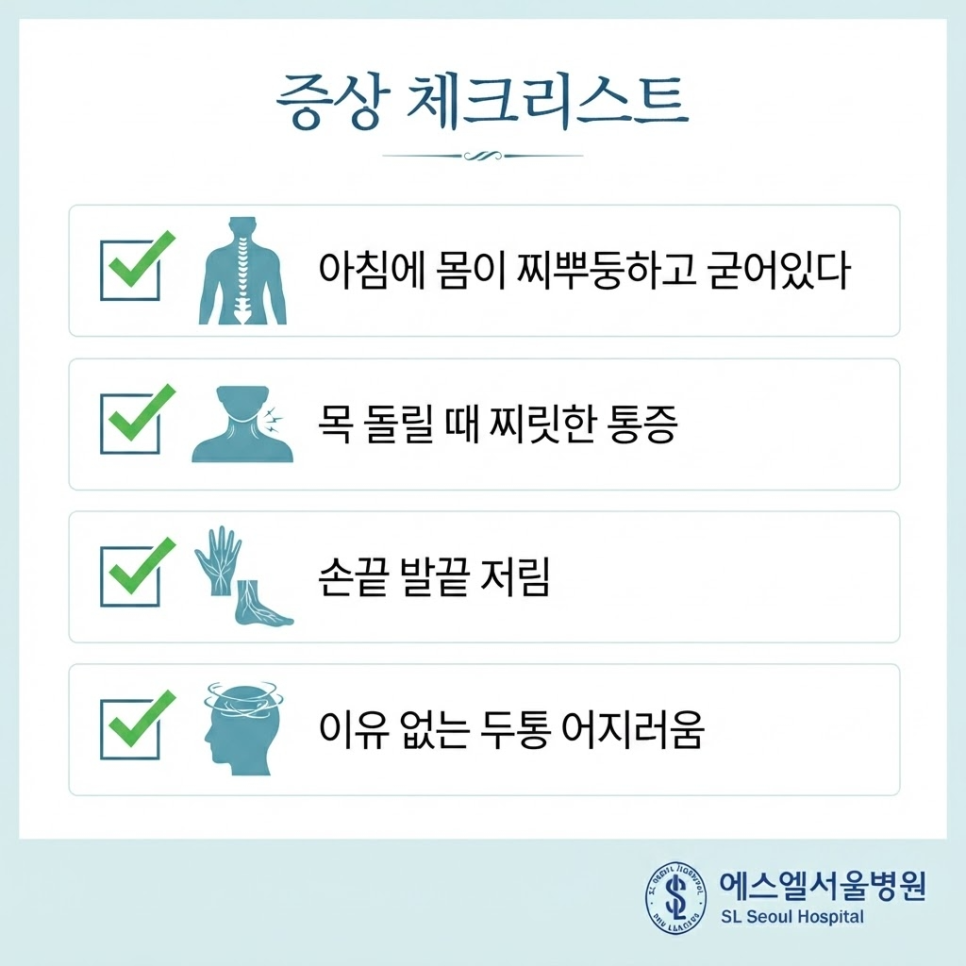
    📋 Symptom Checklist
    ✅ Your body feels stiff and achy when you wake up in the morning
    ✅ You feel a sharp, shooting pain when turning or bending your neck
    ✅ Your fingertips or toes feel numb or tingly
    ✅ Unexplained headaches or dizziness come along with it

    How Do Detailed Exams and Care Work?

    A detailed exam is a diagnostic process aimed at finding hairline fractures and soft-tissue damage that are hard to catch with the naked eye or a standard X-ray.

    These exams are typically carried out in stages, as outlined below.

    🎯 Key Point
    Whiplash symptoms often become more pronounced 2 to 3 days after the accident rather than right away, which is why identifying the extent of the damage early through a detailed exam matters.

    car accident aftereffects — related image 6

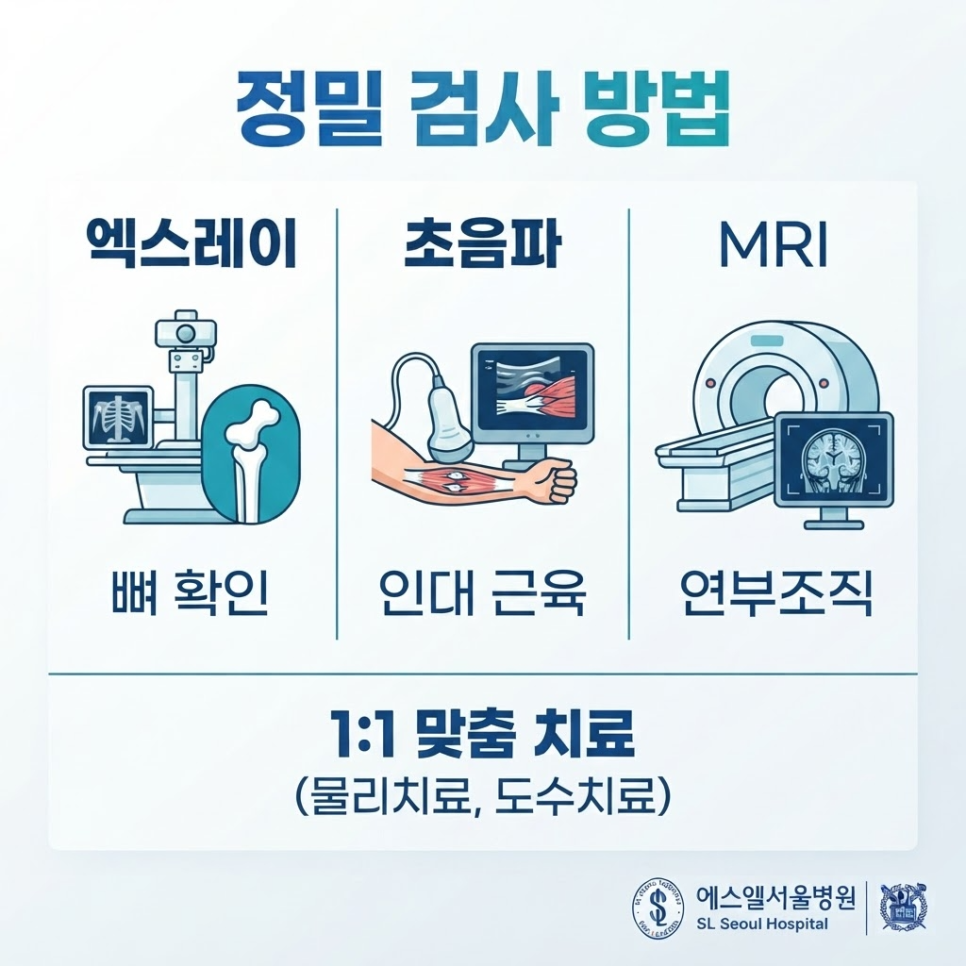
    What Order Do the Exams Follow?

    Stage Exam What It Checks
    Stage 1 X-ray Structural bone issues such as fractures
    Stage 2 Ultrasound Inflammation and damage in muscles and tendons
    Stage 3 MRI Detailed evaluation of soft tissue such as ligaments and nerves

    car accident aftereffects — related image 7

    Based on the exam results, care is tailored one-on-one to each patient’s condition.
    Options range from physical therapy to ease pain to manual therapy that gently loosens tight muscles.

    The SL Seoul Spine & Joint Hospital website also walks through this step-by-step care process in more detail, if you’d like to take a look.

    car accident aftereffects — related image 8

    🚀 Care Approach
    Care is focused on reducing inflammation and restoring joint range of motion, tailored to each person’s pain pattern and degree of injury.

    What Daily Habits Can Support Recovery?

    Day-to-day habits matter just as much as treatment itself.
    The habits you build can make a real difference in how quickly you recover.

    car accident aftereffects — related image 9

    Maintain good posture during the day, and avoid lifting heavy objects when you can.
    At night, use a pillow that isn’t too high to ease the strain on your neck.

    Gentle stretching may help relax tight muscles.
    Try repeating slow, pain-free neck and shoulder rotations on a regular basis.

    car accident aftereffects — related image 10

    ⚠️ Caution
    Stop right away if you feel pain during exercise — pushing through a movement that hurts can slow your recovery instead of helping it.

    Frequently Asked Questions

    1. I didn’t feel any pain right after the accident — can it still show up days later?
    Yes, this is common. Right after a crash, the body is often too tense to register pain clearly, and symptoms tend to surface later once that tension eases.

    2. My X-ray looks normal, so why does it still hurt?
    An X-ray only shows problems with bones, so it can’t reveal subtle damage to muscles, ligaments, or nerves. Soft-tissue injury may be the underlying cause.

    3. How long does recovery usually take?
    It depends on the severity of the injury, age, and individual factors, but consistent care and treatment over several weeks to a few months is often needed.

    4. When can I get back to my normal routine?
    Avoid strenuous activity, but it’s fine to gradually resume light daily activities while keeping an eye on your pain levels.

    5. What should I look for in a Dongducheon orthopedic clinic?
    It’s worth checking whether the clinic offers detailed imaging beyond X-rays — such as ultrasound and MRI — along with personalized physical and manual therapy options.

    car accident aftereffects — related image 11

    car accident aftereffects — related image 12


    References

    · Hidoc Expert Column, “교통사고 후유증으로 인한 경추 손상…’편타손상 증후군’이란?” [Cervical Spine Injury from Car Accident Aftereffects… What Is ‘Whiplash Syndrome’?], Hidoc, 2022. Read more
    · BioTimes, “검사 결과 이상 없다는데 왜 계속 아플까…교통사고 후유증 주의” [Test Results Show Nothing Wrong, So Why Does It Still Hurt… Watch Out for Car Accident Aftereffects], BioTimes, 2026. Read more
    · Hidoc Expert Column, “교통사고 후유증, 언제부터 언제까지 관리해야 할까?” [Car Accident Aftereffects: From When to When Should You Manage Them?], Hidoc, 2026. Read more


    This article is intended for general health information purposes only and is not a substitute for individual diagnosis or treatment. If you’re experiencing symptoms, please consult a medical professional.